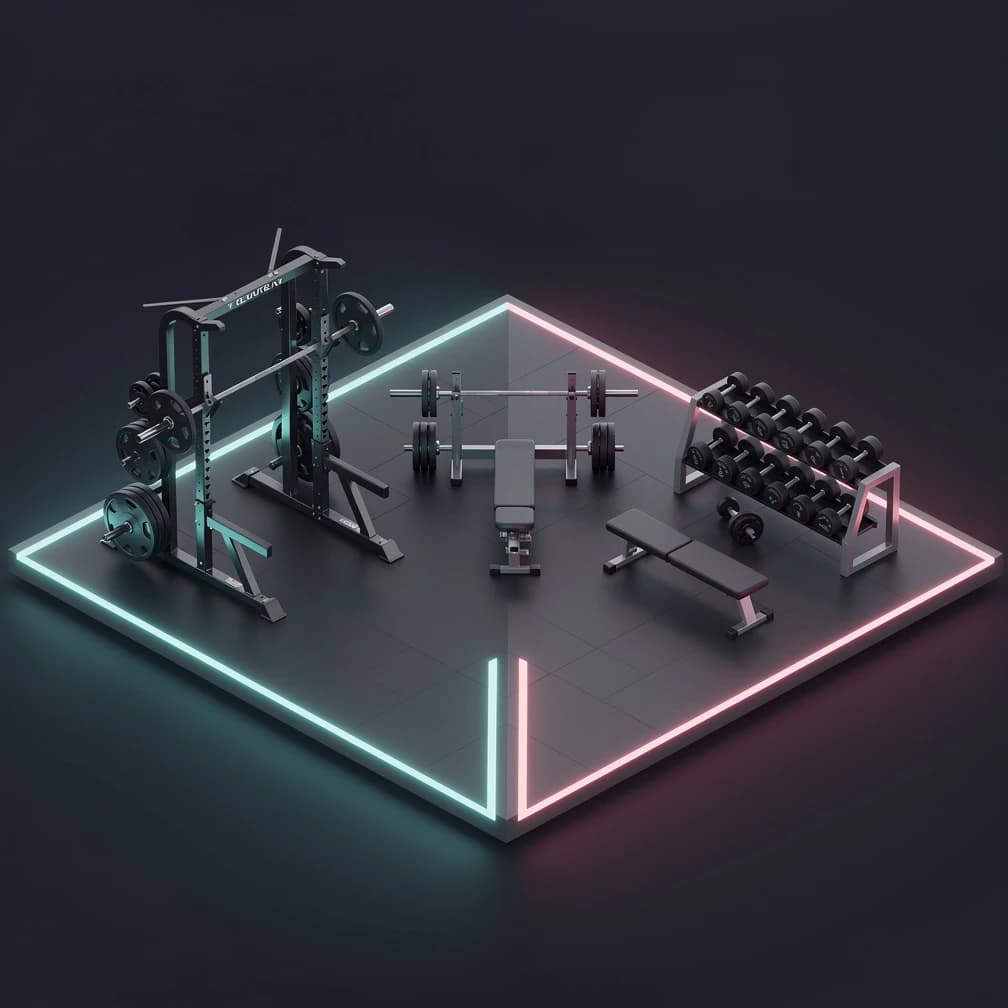
A full body workout trains every major muscle group in a single session. Done consistently three times per week, it produces more total training stimulus per muscle than most split routines — and the research consistently backs this up. If you train 2–3 days per week, want to maximise efficiency, or are new to structured strength training, a full body programme is almost certainly the highest-return approach available to you.
This guide covers what a full body workout actually is, how it compares to split training, how to structure sessions correctly, and a complete 3-day programme you can run for 8–12 weeks.
Key Takeaways
- A full body workout trains every major muscle group — chest, back, shoulders, arms, core, and legs — within a single session
- Training frequency is a primary driver of muscle growth: full body training produces 2–3× weekly stimulus per muscle compared to once-weekly bro splits
- The evidence-based standard for full body training is 3 days per week with at least one full rest day between sessions
- Each session should include 4–6 compound movements targeting the major movement patterns: squat, hinge, push, pull, and carry
- Sets per muscle group in a full body session: 2–4 working sets per movement, targeting 10–20 total sets per muscle per week across all sessions
- Full body training is optimal for beginners, 2–3 day-per-week trainees, athletes maintaining multiple qualities, and anyone returning from a training break
What Is a Full Body Workout?
A full body workout is a resistance training session that directly targets all major muscle groups: chest, back, shoulders, arms (biceps and triceps), core, and legs (quadriceps, hamstrings, glutes, and calves). The goal is to produce a sufficient training stimulus for each muscle group within a single session, rather than dedicating separate sessions to individual muscle groups.
Full body workouts are the opposite of split routines — programmes that divide muscle groups across multiple training days (upper/lower splits, push/pull/legs, or body-part bro splits). Each model has its place, but they serve different training contexts and frequency patterns.
Key characteristics of a full body workout:
- Session duration: Typically 45–75 minutes including warm-up
- Exercises per session: 4–8 compound and accessory movements
- Training frequency: 2–4 sessions per week (most commonly 3)
- Rest days: At least one full rest day between sessions (usually Monday/Wednesday/Friday)
- Volume per muscle per session: 2–4 working sets per movement pattern
The training model is not new. Most early barbell strength programmes — including 5×5, Starting Strength, and their derivatives — are full body protocols. The 5×5 workout built on this philosophy: every session trains the squat, press, and pull in some combination, producing high weekly frequency across all primary movers.
Full Body vs Split Training: Which Is Better?
Neither model is universally superior — the right choice depends on training frequency, experience level, and goals. But for the majority of recreational trainees training 3 days per week, full body training produces better results than splitting muscle groups across fewer sessions.
Here's why:
Muscle protein synthesis (MPS) is a transient process. After a resistance training session, muscle protein synthesis elevates for approximately 24–48 hours before returning to baseline. Training a muscle once per week (as body-part splits do) means there's a 5–6 day window each week where MPS in that muscle is at resting baseline — no growth signal.
A 2016 meta-analysis by Schoenfeld et al. published in the Journal of Sports Sciences found that training each muscle group 2–3 times per week produced significantly greater hypertrophy than training once per week at the same total weekly volume. This is the core evidence for full body training frequency superiority.
Full body training is the frequency solution for limited availability. If training 3 days per week on a body-part split, each muscle group typically gets trained once per week. On a full body programme, each muscle gets trained 3 times — tripling the weekly stimulus for the same training days.
Split training has advantages at higher frequencies. When training 4–6 days per week, split routines allow higher per-session volume per muscle group without excessive session duration. An experienced powerlifter training 5 days per week is better served by an upper/lower or push/pull/legs structure than by 5 full body sessions. The best workout split depends on weekly training frequency more than any other variable.
The frequency advantage: full body vs bro split at 3 days per week
On a 3-day bro split (chest day, back day, legs day), each muscle trains once per week. On a 3-day full body programme, each muscle trains three times per week. Same number of gym visits. Three times the weekly training stimulus. Same or fewer total sets.
Summary:
| Scenario | Better Choice |
|---|---|
| Training 2–3 days per week | Full body |
| Training 4+ days per week | Upper/lower or PPL split |
| Beginner (< 12 months training) | Full body |
| Intermediate (1–3 years) with limited time | Full body |
| Advanced (3+ years) with high frequency | Splits |
| Athlete maintaining multiple qualities | Full body |
| Returning from a layoff | Full body |
The Science Behind Full Body Training Frequency
The case for full body training is built on the relationship between training frequency and muscle hypertrophy — and the data is consistent.
A 2018 systematic review by Ralston et al. published in Sports Medicine found that higher training frequency (2–3 times per week per muscle group) produced superior strength and hypertrophy outcomes compared to lower frequencies when total weekly volume was equated. Critically, when frequency was increased without equating volume — i.e., training more often with the same total weekly sets — results were even better.
The practical implication: spreading your weekly training volume across more sessions (full body 3× per week) is more effective than concentrating the same volume into fewer sessions (split 1× per week per muscle).
The NSCA guidance on training frequency recommends training each major muscle group 2–3 times per week for both strength and hypertrophy — the exact pattern produced naturally by a 3-day full body schedule.
For coaches managing client programming, this has a straightforward implication: for clients training 3 days per week, a full body programme is almost always the correct prescription over a push/pull/legs split that trains each muscle once weekly at insufficient volume.
How to Structure a Full Body Workout
Every full body session should include movements across the five primary movement patterns. These patterns collectively target all major muscle groups:
1. Squat pattern — quadriceps, glutes, hamstrings, core
Examples: Back squat, front squat, goblet squat, leg press
2. Hip hinge pattern — posterior chain (hamstrings, glutes, lower back)
Examples: Deadlift, Romanian deadlift, kettlebell swing, hip thrust
3. Horizontal push — chest, anterior deltoid, triceps
Examples: Bench press, push-up, dumbbell press, cable press
4. Horizontal pull — back (lats, rhomboids, rear delts), biceps
Examples: Barbell row, dumbbell row, cable row, chest-supported row
5. Vertical push/pull — shoulders, upper back, biceps, triceps
Examples: Overhead press, pull-up, lat pulldown, Arnold press
Including at least one exercise from each pattern ensures no major muscle group is neglected. For accessory work, add isolation movements for arms, calves, or core at the end of the session as time permits.
Session structure:
- Warm-up (10 minutes): General movement preparation (2–3 minutes light cardio) + specific warm-up sets for the first primary movement
- Primary compound movements (30–40 minutes): 3–4 main exercises, prioritised by neurological demand — heaviest and most technically demanding first
- Secondary compound or accessory work (10–20 minutes): 2–3 exercises addressing specific muscle groups or weak points
- Optional isolation work (5–10 minutes): Arms, calves, rotator cuff — at the end when fatigue doesn't compromise heavier work
Programming Variables for Full Body Training
Sets per exercise: 2–4 working sets per movement. For beginners, 2–3 working sets produce significant adaptation. Intermediate trainees benefit from 3–4 working sets on primary movements.
Reps per set: The rep range depends on goal:
- Strength focus: 3–6 reps at higher loads (80–90% 1RM)
- Hypertrophy focus: 6–12 reps (65–80% 1RM)
- Muscular endurance: 12–20 reps (lighter loads)
Most full body programmes use a mixed-rep approach — lower reps on compound movements (5–8) and higher reps on accessory work (10–15).
Weekly volume: Target 10–20 working sets per muscle group per week across all sessions. For a 3-day full body programme, that means 3–7 sets per muscle per session — achievable with 2–3 exercises covering each pattern.
Exercise selection per session: Keep it to 4–6 main movements per session to manage fatigue and session duration. Quality sets outperform junk volume every time.
Progressive overload: The engine of adaptation. Add weight when you can hit the top of the rep range on all working sets with good form. For beginners, weekly load increases are achievable; for intermediates, monthly or block-based progression is more realistic. Progressive overload applied consistently over 8–12 week blocks drives the vast majority of long-term results.
Rest between sets: 2–3 minutes between heavy compound sets; 60–90 seconds between accessory work. Rushing rest periods on compound movements reduces mechanical tension and load — the primary drivers of strength and hypertrophy.
3-Day Full Body Workout Plan
This programme is built for beginners and early intermediates training 3 days per week. It runs for 8–12 weeks before progressing to a more advanced structure. Sessions are sequenced to alternate primary movement emphases across the week.
Schedule: Monday / Wednesday / Friday (or any three non-consecutive days)
Session duration: 55–65 minutes including warm-up
Progressive overload rule: When you hit the top of the rep range on all sets with good form, increase load by 2.5–5kg on barbell movements, 1–2.5kg on dumbbell movements.
Session A (Monday)
| Exercise | Sets × Reps | Rest |
|---|---|---|
| Barbell Back Squat | 3 × 5–8 | 3 min |
| Barbell Bench Press | 3 × 5–8 | 3 min |
| Barbell Bent-Over Row | 3 × 6–8 | 2.5 min |
| Romanian Deadlift | 3 × 8–10 | 2 min |
| Overhead Press | 3 × 8–10 | 2 min |
| Dumbbell Curl | 2 × 10–12 | 60 sec |
| Tricep Pushdown | 2 × 10–12 | 60 sec |
Session B (Wednesday)
| Exercise | Sets × Reps | Rest |
|---|---|---|
| Conventional Deadlift | 3 × 4–6 | 3 min |
| Incline Dumbbell Press | 3 × 8–10 | 2.5 min |
| Pull-Up or Lat Pulldown | 3 × 6–10 | 2.5 min |
| Goblet Squat | 3 × 10–12 | 2 min |
| Dumbbell Row | 3 × 10 each | 90 sec |
| Lateral Raise | 3 × 12–15 | 60 sec |
| Face Pull | 2 × 15 | 60 sec |
Session C (Friday)
| Exercise | Sets × Reps | Rest |
|---|---|---|
| Front Squat or Leg Press | 3 × 8–10 | 2.5 min |
| Cable or Machine Row | 3 × 10–12 | 2 min |
| Dumbbell Bench Press | 3 × 8–10 | 2 min |
| Hip Thrust or Glute Bridge | 3 × 10–12 | 2 min |
| Arnold Press | 3 × 10–12 | 90 sec |
| Hammer Curl | 2 × 12 | 60 sec |
| Overhead Tricep Extension | 2 × 12 | 60 sec |
Notes:
- Week 1–4: Use the prescribed loads, focusing on technique and hitting the rep ranges consistently
- Week 5–8: Increase loads on any exercise where you've consistently hit the top of the rep range on all sets
- Week 9–12: Add a fourth working set to the primary compound movements (squat, deadlift, bench, row) before progressing to a higher-volume intermediate programme
Equipment alternatives: No barbell? Replace back squats with goblet squats or leg press, deadlifts with trap bar or dumbbell Romanian deadlifts, bench press with dumbbell press or push-up variations. The movement patterns remain; the implements are interchangeable.
Can You Do Full Body Workouts Every Day?
No — not productively. Full body training taxes the central nervous system (CNS) and the primary muscle groups across the entire session. Recovery from compound movements — particularly squats and deadlifts — requires 48–72 hours before another quality stimulus can be applied to the same muscles.
Daily full body training leads to:
- Accumulating fatigue that reduces training quality by mid-week
- Diminishing adaptation as insufficient recovery time limits muscle protein synthesis completion
- Elevated injury risk from cumulative mechanical stress without adequate repair time
The three-days-per-week standard (Mon/Wed/Fri or Tue/Thu/Sat) emerged from the evidence, not convention. It provides the optimal balance of stimulus and recovery for most trainees.
What's different about active recovery days? Light movement — walking, mobility work, recreational activity — is appropriate on rest days and may actively support recovery. The distinction is between light activity (fine) and additional resistance training sessions targeting the same muscle groups (counterproductive).
Can advanced athletes train more often? Yes — with appropriate programming. A 4-day full body schedule (Mon/Tue/Thu/Fri) with alternating emphasis and volume management is achievable for intermediate-advanced trainees. However, beyond 4 full body sessions per week, switching to a split routine is almost always more productive.
Common Full Body Workout Mistakes
Mistake 1: Too many exercises per session. Trying to include 10+ exercises in a full body session extends the session beyond productive duration, reduces quality on later exercises, and doesn't add meaningful volume. 4–6 well-chosen movements done with full effort produce far better results.
Mistake 2: No compound movements. Full body workouts built around machines and isolation exercises miss the primary stimulus. Compound movements — squat, hinge, push, pull — recruit more muscle mass, produce greater anabolic hormonal response, and build more strength per hour than any isolation-based alternative.
Mistake 3: Every session the same. Running the same three exercises every session adapts the body to the same pattern, depletes specific muscles disproportionately, and produces accommodation. Alternating between session A, B, and C (as in the programme above) ensures variation across the week while maintaining the movement pattern coverage.
Mistake 4: Neglecting the posterior chain. Many trainees prioritise quad-dominant squatting and pushing movements while undertraining the posterior chain — glutes, hamstrings, upper back, and rear delts. These muscle groups are critical for posture, injury prevention, and athletic performance. Every full body session should include at least one hinge movement and one horizontal pull.
Mistake 5: Skipping the warm-up on compound movements. Performing the first working set of a deadlift or squat cold leads to poor technique, higher injury risk, and suboptimal mechanical output on the set itself. Specific warm-up sets (2–3 sets at progressively increasing loads before the first working set) are not optional. For workout sets guidance, warm-up sets don't count toward your working set total.
Mistake 6: Ignoring progressive overload. A full body programme that doesn't systematically increase demands over time produces adaptation for 4–6 weeks and then plateaus. Tracking session data and applying progressive overload — adding reps, weight, or sets over time — is what separates trainees who keep improving from those who stall.
How Coaches Use Full Body Training with Clients
Full body programming is the default starting point for most new coaching clients — regardless of age, gender, or initial fitness level. The rationale is consistent with the evidence: new trainees respond to frequency, not volume; technique is being established across all movement patterns simultaneously; and three well-managed sessions per week is achievable for most adult schedules.
For coaches managing multiple clients with varying experience levels, full body templates offer another advantage: lower session-to-session complexity. A beginner's full body programme can be built around 5–6 movements that remain consistent week to week, with load as the only variable that changes. This simplicity supports adherence and makes progress straightforward to track.
Where coaches customise:
Movement selection based on equipment access. A client training at home gets a goblet squat, push-up progression, and dumbbell row. A client at a commercial gym gets the full barbell menu. The pattern coverage is identical; the implementation differs.
Rep range selection based on goal. A client prioritising strength skews lower in the rep range (4–6) on primary movements. A client prioritising muscle gain uses the hypertrophy range (8–12). These adjustments happen within the same full body template — the structure doesn't change, the targets do.
Volume progression across the programme block. A coach using a structured program builder tracks session-by-session performance data and adjusts load, sets, and rep targets based on actual client output rather than generic templates. When a client consistently hits the top of the rep range on squats, the coach increases load for the next session. This individualised progression drives far better outcomes than self-directed training where load decisions are intuitive.
Transitioning to split training. At some point — typically after 12–18 months of consistent training — the once-daily stimulus from full body training becomes insufficient for continued progress on a 3-day schedule. The coach's job is to recognise this transition point and evolve the programme architecture: typically to an upper/lower split at 4 days, then to a push/pull/legs or more advanced structure at 5–6 days.
For coaches delivering online strength coaching, full body programmes also simplify client communication. With fewer exercise slots per session, clients have less opportunity to deviate from the plan, and coaches can monitor technique across a smaller movement set — which improves the feedback cycle and programme adherence simultaneously.
Full Body Training: The Right Baseline for Most Trainees
Full body training is not just for beginners. It is the most evidence-aligned structure for anyone training 2–3 days per week, regardless of experience. The frequency advantage it provides — stimulating each muscle 3× weekly rather than 1× — compounds over months of training, producing measurably superior strength and hypertrophy outcomes at the same weekly training time investment.
For coaches, it's the correct default programme architecture for most adult clients. For self-directed trainees, it's the highest-return structure available within a 3-day-per-week schedule. The hypertrophy and strength science consistently points in the same direction: frequency matters, and full body training delivers it naturally.
The 3-day programme in this article is a starting point. Run it for 8–12 weeks, add load progressively, and track whether you're consistently hitting the rep targets at each session. When you've exhausted the progression and want more training days, that's the moment to explore split training. Until then, the full body template compounds.
Frequently Asked Questions
A full body workout is a resistance training session that targets all major muscle groups — chest, back, shoulders, arms, core, and legs — within a single session. Rather than dedicating separate sessions to individual muscle groups (as split routines do), full body training applies a training stimulus to every primary mover each session. It's typically performed 3 days per week with at least one rest day between sessions.
For trainees training 2–3 days per week, full body workouts are more effective than split routines at the same training frequency because each muscle group receives 2–3× the weekly stimulus. Research by Schoenfeld et al. (2016) confirmed that training muscles 2–3 times per week produces greater hypertrophy than once per week at the same total volume. Splits become superior only when frequency reaches 4+ days per week, where per-session volume per muscle group can be meaningfully higher.
No — not productively. Full body workouts tax the central nervous system and all primary muscle groups. Recovery from compound movements (squat, deadlift, press, row) requires 48–72 hours before another quality stimulus can be applied. Daily full body training leads to accumulated fatigue, reduced session quality, and elevated injury risk. The evidence-based standard is 3 full body sessions per week on non-consecutive days.
4–6 compound and accessory exercises per session is the optimal range. This covers the primary movement patterns (squat, hinge, push, pull, vertical press/pull) plus 1–2 isolation movements for arms, calves, or specific weak points. More than 6–8 exercises per session extends session duration without proportionally increasing productive volume, and session quality declines on later exercises as fatigue accumulates.
55–70 minutes is the typical duration for an effective full body workout including warm-up. This time frame allows 4–6 movements with proper rest periods between compound exercise sets (2–3 minutes) without extending to the point where fatigue compromises later sets. Sessions extending beyond 90 minutes typically accumulate junk volume — additional sets that don't produce meaningful additional stimulus because fatigue limits effort quality.
The optimal choice depends on your weekly training frequency. Training 2–3 days per week: full body is superior because it provides higher frequency per muscle group. Training 4–5 days per week: upper/lower or push/pull/legs splits are superior because they allow higher per-session volume per muscle without excessive session duration. Training 6+ days per week: body-part splits allow the highest per-session muscle group volume. Most recreational trainees training 3 days per week are best served by a full body programme.
The best full body workout exercises target all major movement patterns: squats or leg press (squat pattern), deadlifts or Romanian deadlifts (hip hinge), bench press or push-ups (horizontal push), rows (horizontal pull), overhead press (vertical push), and pull-ups or lat pulldowns (vertical pull). These six movement patterns cover all major muscle groups. Add isolation work for biceps, triceps, and calves at the end of sessions as time permits.
Sources & References
- Schoenfeld et al. 2016 — Resistance Training Frequency Meta-Analysis — Training each muscle 2–3× per week produces greater hypertrophy than once weekly at equated volume
- Ralston et al. 2018 — Training Frequency Systematic Review — Higher frequency associated with superior strength and hypertrophy outcomes
- NSCA: Training Frequency for Strength Development — Professional body guidance on optimal frequency for strength and hypertrophy goals
- Schoenfeld et al. 2017 — Volume Dose-Response — Weekly training volume and its dose-response relationship with muscle hypertrophy
- ACSM Physical Activity Guidelines for Resistance Training — Authoritative public health recommendations for resistance training frequency for adults