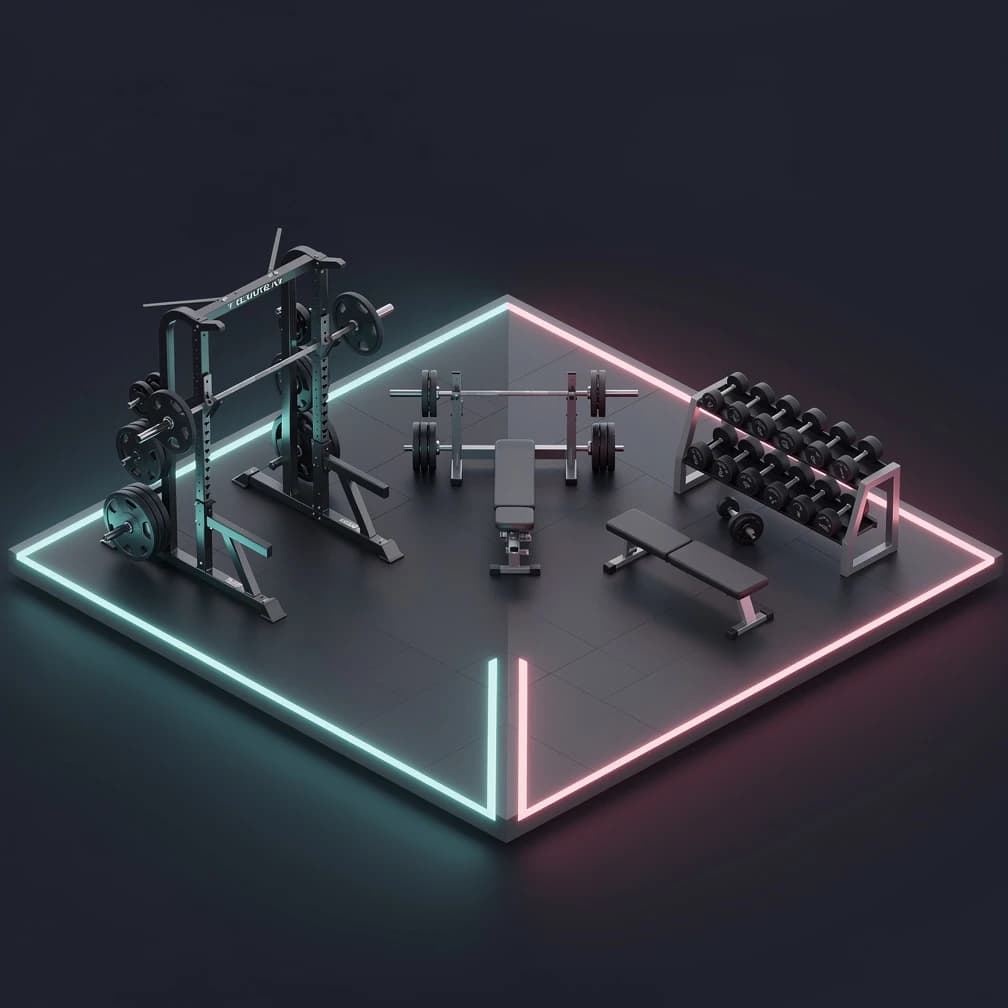
Strength training is resistance training organised to make a muscle produce more force, and it is the foundation that every other physical goal — visible muscle, athletic performance, long-term health — sits on top of. A stronger lifter has more usable muscle for the same body weight, more tendon and bone density, more capacity to tolerate hypertrophy volume, and more performance ceiling in every sport that involves pushing, pulling, jumping, or carrying. Yet the bare phrase "strength training" still gets used interchangeably with "weight lifting", "bodybuilding", "resistance training", and "lifting", which collapses real programming distinctions into a vague blur.
This guide draws the lines: what strength training is and is not, how it actually builds strength at the neural and structural level, the five programming variables that define every plan (volume, intensity, frequency, exercise selection, rest), three full sample templates for beginner through intermediate-advanced, the progression and periodisation models that decide what changes week to week, and the coach-side prescription playbook for matching a programme to a client's training age and goal.
Key Takeaways
- Strength training is structured resistance training that drives both neural adaptations (motor unit recruitment, rate coding, coordination) and structural adaptations (myofibrillar hypertrophy, tendon stiffness, bone density)
- It is distinct from bodybuilding (physique-focused), hypertrophy training (growth-focused), powerlifting (competition-focused on three lifts), and weightlifting (competition-focused on snatch and clean-and-jerk) — though all four use strength training as a foundation
- The five programming variables that define every plan are volume (sets per muscle per week), intensity (% of 1RM or RPE), frequency (sessions per muscle per week), exercise selection (compound primary + accessory), and rest (2-5 minutes between heavy sets)
- The American College of Sports Medicine 2009 Position Stand recommends novices train at 60-70% 1RM for 8-12 reps, intermediates at 70-80% for 6-12 reps, and advanced lifters at 80-100% for 1-6 reps with progressive overload
- Programme hopping is the most common reason intermediate lifters stop progressing — pick a template, run it for 8-12 weeks with a clear progression scheme, deload every 4-6 weeks, and only switch when adaptation has clearly stalled
- IronCoaching's program builder lets coaches prescribe strength templates with percentage-of-1RM tracking, RPE/RIR targets, and weekly volume dashboards per muscle group — the infrastructure that makes individualised strength programming sustainable past 10 clients
What Is Strength Training?
Strength training is any form of structured resistance work whose primary goal is to increase the force a muscle (or coordinated muscle group) can produce against an external load. The defining feature is the goal — neuromuscular force production — not the equipment. A barbell back squat is strength training. A bodyweight pistol squat at the limit of execution is strength training. A heavy sled push is strength training. The common thread is that the load is high enough, the rep range low enough, and the rest long enough that the lifter is recruiting near-maximal motor units on each set.
It is helpful to distinguish strength training from four adjacent practices it is often confused with.
Strength training vs. bodybuilding. Bodybuilding is a sport whose objective is judged physique. Strength training is a method bodybuilders use, alongside hypertrophy training, posing practice, and nutritional manipulation. A bodybuilder may strength-train in the off-season to raise the hypertrophy ceiling, but their primary training stimulus is muscle growth, not force production.
Strength training vs. hypertrophy training. Hypertrophy training targets structural muscle growth. It uses moderate loads (60-80% 1RM), moderate-to-high reps (6-15+), and shorter rest (60-120s) to maximise mechanical tension across the full rep range and accumulate metabolic stress. Strength training uses heavier loads (80-100% 1RM), lower reps (1-6), and longer rest (2-5 minutes) to drive neural recruitment. The two qualities overlap — heavy strength work grows muscle, and high-quality hypertrophy work builds some strength — but the programming variables are distinct. See the hypertrophy vs. strength comparison for the full breakdown and the combined-programming guide for how to run both at once.
Strength training vs. powerlifting. Powerlifting is a sport: three lifts (squat, bench, deadlift), one attempt at a one-rep max in each. Powerlifters strength-train, but their programming is heavily skewed toward the three competition lifts and toward peaking blocks before meets. A recreational lifter doing 5/3/1 is strength training; a competing powerlifter doing 5/3/1 plus opener work in the final 4 weeks before a meet is powerlifting.
Strength training vs. weightlifting. Weightlifting is the Olympic sport of the snatch and clean-and-jerk — explosive, full-body, technically demanding lifts that train maximal power as much as maximal strength. Weightlifters strength-train (squats, pulls, presses) as preparation, but the sport itself is power expression, not pure force production.
Inside the umbrella of strength training there are four sub-qualities that a programme can target.
| Quality | Primary adaptation | Rep range | Intensity | Rest |
|---|---|---|---|---|
| Maximal strength | Neural recruitment, rate coding | 1-6 | 80-100% 1RM | 3-5 min |
| Hypertrophy | Muscle cross-sectional area | 6-15 | 60-80% 1RM | 60-120s |
| Power | Rate of force development | 1-5 (explosive) | 40-70% 1RM | 2-4 min |
| Strength-endurance | Fatigue resistance | 12-25 | 40-60% 1RM | 30-60s |
Most programmes train more than one of these qualities in a given block. Pure single-quality blocks are appropriate for competitive athletes in peaking phases — a powerlifter in the final six weeks before a meet, a bikini competitor in the final eight weeks before stage. Outside those windows, mixed programming is the right default.
Why Strength Training Matters
Strength training earns its place at the centre of fitness for reasons that extend well beyond gym goals.
Health and longevity. The Westcott 2012 review in Current Sports Medicine Reports summarised the evidence: regular resistance training increases lean mass, raises resting metabolic rate, improves insulin sensitivity, lowers resting blood pressure, increases bone mineral density, and reduces all-cause mortality. The World Health Organization and the American College of Sports Medicine both recommend at least two strength-training sessions per week targeting the major muscle groups for every adult.
Athletic performance. The Suchomel, Nimphius, Bellon, and Stone 2018 review argued that muscular strength is the foundational quality for athletic performance. Strength predicts sprint speed, jump height, change-of-direction ability, and injury resistance across sports. An athlete cannot express maximal power without maximal force production capacity, because power is force × velocity — and there is no velocity output without a force baseline.
Body composition. Strength training preserves lean mass during a caloric deficit, which is the single most reliable defence against the muscle loss that accompanies most weight-loss attempts. It also raises the metabolic floor — a kilogram of muscle burns more calories at rest than a kilogram of fat — which compounds over years into easier weight maintenance.
Daily function. The everyday tasks that adults lose first to age — climbing stairs, carrying groceries, rising from a chair, recovering from a stumble — are all force-production tasks. Strength training trains the exact movement patterns those tasks demand: hip hinge (deadlift), knee bend (squat), vertical push (overhead press), horizontal push (bench), pull (row, chin-up). A lifter who can squat double bodyweight at 65 is not lifting double bodyweight at 65; they are climbing stairs without thinking about it.
The mechanism behind all these benefits is the same: structured overload on the musculoskeletal system drives an adaptive response, and that adaptation is what we call strength.
How Strength Is Built
A first-time lifter gains strength visibly fast — sometimes 30-50% on a major lift in the first three months — but the muscle is not growing at anywhere near that rate. The early gains are almost entirely neural. The structural gains come later and continue for years.
Neural adaptations dominate the first 4-6 weeks of training. The nervous system learns to recruit more motor units in a single contraction (intramuscular coordination), to fire them at higher frequencies (rate coding), to recruit them earlier in the rep (synchronisation), and to coordinate multiple muscles across the joint to produce force in the same direction (intermuscular coordination). The muscle is not bigger; the lifter is using more of what they already had.
Structural adaptations take 8-12 weeks to become measurable. Muscle fibres expand through myofibrillar hypertrophy (more contractile units in parallel) and, to a smaller extent, sarcoplasmic hypertrophy (more fluid and substrate inside the cell). Tendons stiffen, which improves force transfer. Bone mineral density increases under repeated mechanical loading. Connective tissue around the muscle (fascia, endomysium) thickens. None of these change a one-rep max in the first month — but over a year, they are what separate a novice from an intermediate.
The two timelines together explain a counterintuitive coaching observation: a beginner running a poorly designed programme often makes faster early progress than an intermediate running a well-designed programme. The beginner's nervous system is unlocking dormant capacity. The intermediate is asking their body to grow new tissue, which is slower.
The practical implication for programming: novice templates that exploit linear progression on the same set/rep scheme for months work because the nervous system can absorb that overload. Intermediate templates that vary intensity and volume across the week (DUP) or across blocks (block periodisation) work because structural adaptation requires more varied stimulus.
The Five Programming Variables
Every strength training programme is defined by five variables. Change any one and you change the adaptation. Knowing which variable does what is the difference between a programme that builds strength and a programme that builds fatigue.
Volume
Volume is the total amount of work performed. The most useful measure for strength and hypertrophy programming is hard sets per muscle group per week — sets taken close enough to failure to be a real growth or strength stimulus, distinct from warm-up sets. The Schoenfeld, Grgic, Ogborn, and Krieger 2017 meta-analysis on volume found that 10+ sets per muscle per week drive maximal hypertrophy, with a dose-response curve that flattens above roughly 20 sets in most lifters.
For pure strength training, weekly sets per primary lift matter more than per muscle group. A common framework is:
- Novice: 10-15 working sets per primary lift per week
- Intermediate: 15-20 working sets per primary lift per week, with hypertrophy accessory volume on top
- Advanced: 12-20 working sets per primary lift per week (volume gets harder to recover from at higher intensities)
The framework that ties weekly volume to actual progress is MEV / MAV / MRV — Minimum Effective Volume, Maximum Adaptive Volume, Maximum Recoverable Volume. The how many sets per muscle group guide covers the full reference tables by training age and muscle group, and the workout sets guide covers the distinction between working and warm-up sets.
Intensity
Intensity is how heavy the load is relative to a one-rep max (% 1RM) or how close each set is to failure (RPE — Rate of Perceived Exertion, or RIR — Reps in Reserve). The two are related but not interchangeable.
For strength training, the load zones map roughly to:
| Goal | % 1RM | Reps | RPE |
|---|---|---|---|
| Maximal strength | 85-100% | 1-5 | 8-10 |
| Strength | 75-85% | 4-8 | 7-9 |
| Hypertrophy (strength-biased) | 70-80% | 6-10 | 7-9 |
| Hypertrophy (size-biased) | 60-75% | 8-15 | 7-9 |
RPE-based autoregulation is the more practical model for most lifters because true 1RM is a moving target and percentages stop reflecting daily readiness. The RPE vs RIR guide covers the autoregulation framework in detail.
Frequency
Frequency is the number of times per week a muscle or movement pattern is trained. The research-backed minimum for an adaptation response is two sessions per muscle per week — once-weekly muscle training works for absolute beginners but plateaus quickly. Higher frequencies (three to four sessions per muscle per week) become useful at higher volumes because they distribute the weekly set total into smaller, better-recovered chunks.
The frequency-volume relationship is the deciding factor in split choice. A 3-day full-body programme hits each muscle three times per week at moderate volume. A 4-day upper/lower splits the body in two and trains each half twice. A 5-day push/pull/legs+ splits across three pattern groups and trains each twice in a 7-day cycle. The best workout split guide compares the splits in detail.
Exercise Selection
A strength programme rests on a small number of primary compound lifts — squat, bench press, deadlift, overhead press, row — that train large muscle groups across multiple joints with heavy loads. Secondary compounds (front squat, Romanian deadlift, incline press, weighted dip, weighted chin-up) extend the primary lift selection without adding the same recovery cost. Isolation work (curls, lateral raises, leg curls, triceps pushdowns, calf raises) fills gaps for weak points and adds volume without spinal loading.
The movement-pattern checklist for a complete strength programme:
- Knee-dominant squat pattern — back squat, front squat, leg press, split squat
- Hip-dominant hinge pattern — deadlift, Romanian deadlift, hip thrust, good morning
- Horizontal push — bench press, dumbbell press, push-up variant
- Horizontal pull — bent-over row, seated row, chest-supported row
- Vertical push — overhead press, push press, dumbbell press
- Vertical pull — pull-up, chin-up, lat pulldown
- Loaded carry / core — farmer's walk, ab wheel, hanging leg raise, plank variants
A programme that misses any of these patterns leaves a strength gap that will eventually limit the primary lifts. The most common omission is the posterior chain (hip hinge, vertical and horizontal pull) — lifters train what they can see, and weak hamstrings, glutes, and upper back create both injury risk and a strength ceiling on the lifts they do train.
Rest Periods
Rest between sets is the most commonly under-prescribed variable. For maximal strength work, the meta-analytic evidence supports 2-5 minutes between heavy sets to allow phosphocreatine resynthesis and full force production on the next set. Cutting rest to 60-90 seconds turns strength work into hypertrophy work — the load on the bar drops, total force production per set drops, and the neural stimulus shifts.
For hypertrophy accessories within the same session, 60-120 seconds is fine. For pure power work, 2-4 minutes. The simplest rule: rest until the work feels repeatable at the same RPE.
Methods of Strength Training
The equipment a lifter trains with matters less than how they programme it, but each method has tradeoffs worth naming.
A complete strength programme typically uses barbells for the primary compound lifts (load matters), dumbbells or machines for secondary compounds, and isolation work on either machines or cables. Bodyweight has a place in conditioning blocks and as an emergency tool when access to a gym is interrupted, but it cannot replace barbell training for the strength ceiling.
Sample Template 1 — Beginner 3-Day Full Body
The novice lifter has a single job: add load to the bar every session on the primary lifts until linear progression stops. A 3-day full-body programme exploits the beginner adaptation window — the nervous system unlocking dormant motor unit recruitment — and uses minimum-effective volume per session because frequency does the work.
Week structure: Monday / Wednesday / Friday, all three sessions identical in pattern with alternating squat and deadlift days.
| Session A (Mon, Fri) | Sets × Reps | Notes |
|---|---|---|
| Back squat | 3 × 5 | Linear progression: +5 lb each session |
| Bench press | 3 × 5 | Linear progression: +2.5 lb each session |
| Bent-over row | 3 × 5 | Linear progression: +2.5 lb each session |
| Session B (Wed) | Sets × Reps | Notes |
|---|---|---|
| Back squat | 3 × 5 | +5 lb |
| Overhead press | 3 × 5 | +2.5 lb |
| Conventional deadlift | 1 × 5 | +10 lb |
This is the StrongLifts 5×5 / Starting Strength family of programmes. The 5×5 workout programme guide covers the full version with chin-ups and accessory recommendations. Run it until you stall twice on the same lift at the same weight — typically 3-6 months for most beginners — then graduate.
Sample Template 2 — Intermediate 4-Day Upper / Lower
Once linear progression stops, the intermediate lifter needs more volume and variation per week. A 4-day upper/lower split trains each half of the body twice per week, splits strength and hypertrophy work into separate sessions per movement pattern, and gives 48-72 hours between sessions targeting the same muscle.
Week structure: Mon Upper Strength / Tue Lower Strength / Thu Upper Hypertrophy / Fri Lower Hypertrophy.
| Mon — Upper Strength | Sets × Reps | RPE |
|---|---|---|
| Bench press | 4 × 5 | 8 |
| Bent-over row | 4 × 5 | 8 |
| Overhead press | 3 × 6 | 7 |
| Weighted chin-up | 3 × 6 | 7 |
| Triceps extension | 3 × 10 | 8 |
| Tue — Lower Strength | Sets × Reps | RPE |
|---|---|---|
| Back squat | 4 × 5 | 8 |
| Romanian deadlift | 3 × 6 | 7 |
| Walking lunge | 3 × 10 each | 8 |
| Standing calf raise | 4 × 10 | 8 |
| Hanging leg raise | 3 × 12 | — |
| Thu — Upper Hypertrophy | Sets × Reps | RPE |
|---|---|---|
| Incline dumbbell press | 4 × 10 | 8 |
| Chest-supported row | 4 × 10 | 8 |
| Dumbbell shoulder press | 3 × 12 | 8 |
| Lat pulldown | 3 × 12 | 8 |
| Biceps curl + triceps pushdown superset | 3 × 12 each | 9 |
| Fri — Lower Hypertrophy | Sets × Reps | RPE |
|---|---|---|
| Front squat | 3 × 8 | 8 |
| Hip thrust | 4 × 10 | 8 |
| Leg curl | 3 × 12 | 9 |
| Seated calf raise | 3 × 15 | 8 |
| Ab wheel | 3 × 10 | — |
Progression is double progression: hit the top of the rep range across all working sets at the prescribed RPE, then add load the following week. Deload every 4-6 weeks by dropping intensity to RPE 6 for a single light week. The best workout split guide compares upper/lower against push/pull/legs and full-body for intermediates.
Sample Template 3 — Intermediate-Advanced 5/3/1
Jim Wendler's 5/3/1 is the canonical percentage-based intermediate strength programme. The main work is built on a Training Max set at 85-90% of true 1RM (deliberately conservative). Three weeks of progressive intensity (5s week, 3s week, 1s week) are followed by a deload week, then the Training Max increases by 5 lb (upper) or 10 lb (lower) and the cycle repeats.
Main lift wave (per cycle):
| Week | Set 1 | Set 2 | Set 3 (AMRAP) |
|---|---|---|---|
| 1 (5s week) | 5 reps @ 65% TM | 5 reps @ 75% TM | 5+ reps @ 85% TM |
| 2 (3s week) | 3 reps @ 70% TM | 3 reps @ 80% TM | 3+ reps @ 90% TM |
| 3 (1s week) | 5 reps @ 75% TM | 3 reps @ 85% TM | 1+ reps @ 95% TM |
| 4 (deload) | 5 reps @ 40% TM | 5 reps @ 50% TM | 5 reps @ 60% TM |
The four main lifts (squat, bench, deadlift, overhead press) run one per training day across a 4-day week. Each session adds either Boring But Big (5 × 10 of the main lift at 50-60% TM — a hypertrophy block) or a different assistance template depending on goal. The 5/3/1 workout programme guide covers the variants in full.
5/3/1 fits the intermediate-to-advanced lifter who has stalled on linear progression and needs a long-horizon, predictable, autoregulated framework. It is also the canonical concurrent strength-plus-hypertrophy template — see the hypertrophy and strength training guide for how it integrates both qualities.
Progression — How the Numbers Change Over Time
A strength programme without a progression scheme is a workout — useful in the moment, but not adaptive. Three progression models cover almost every case.
Linear progression. Add load to the bar every session on the primary lifts. Works for beginners through the first 3-6 months because the nervous system can absorb the overload. Stops working when the lifter is no longer in the novice adaptation window — the signal is two consecutive stalls at the same weight on the same lift.
Double progression. Add reps within a fixed range, then add load. Hit 3 × 8 at the prescribed weight; next session try for 3 × 9; when you hit 3 × 10, add 5 lb and reset to 3 × 8. Works for intermediates because it decouples the load progression from the session-to-session noise of daily readiness.
Percentage-based progression. Use a Training Max anchored to recent performance, run a wave of prescribed intensities, and bump the Training Max at the end of each cycle. The 5/3/1 model is the canonical example. Works for intermediates and advanced lifters because it constrains intensity to ranges that can be sustained for years without overreaching.
A complete programme also defines a deload trigger. The simplest version: deload every 4-6 weeks regardless of how training feels, by dropping intensity to RPE 6 (or 40-60% of Training Max) for a single light week. The autoregulated version: deload when RPE creeps above 9 on prescribed sets for two consecutive sessions, or when a working weight is missed on a session where it should have been comfortable. The progressive overload training programme guide covers the deload mechanics and the failed-rep response in detail.
Periodisation — How the Block Structure Changes
Periodisation is how the variables (volume, intensity, exercise selection) shift across blocks of training. Three models dominate strength programming.
Linear periodisation moves from higher volume / lower intensity in early blocks to lower volume / higher intensity in later blocks. A 12-week strength block might run 4 × 8 at 70% for weeks 1-4, 4 × 6 at 77% for weeks 5-8, and 4 × 4 at 85% for weeks 9-12, peaking into a test or competition. Best for athletes with discrete peaking events.
Undulating periodisation rotates intensity day-to-day (Daily Undulating Periodisation, DUP) or week-to-week (Weekly Undulating Periodisation). Monday is a strength day at 4 × 4 @ 85%, Wednesday a hypertrophy day at 4 × 10 @ 70%, Friday a power day at 6 × 3 @ 75% with speed intent. Best for intermediates with no fixed peaking event and dual quality goals.
Block periodisation runs concentrated single-quality blocks in sequence — 4-6 weeks of pure strength, 4-6 weeks of pure hypertrophy, 4-6 weeks of peaking — separated by deloads. Best for advanced lifters whose adaptations require more concentrated stimulus to overcome staleness.
The strength training periodisation guide covers the model comparison, the research support, and the templates in detail.
Recovery and Nutrition Basics
Strength is built between sessions, not during them. Three recovery levers move the needle.
Sleep. 7-9 hours per night is the non-negotiable foundation. Sleep restriction reduces force production, slows recovery, and elevates injury risk in nearly every study that has measured it. A lifter sleeping six hours is leaving strength on the table no matter how good the programme.
Calorie status. Strength gains are easiest at maintenance or in a small surplus (200-400 kcal/day above maintenance). A moderate deficit (15-25% below maintenance) preserves strength on existing lean mass but slows new strength acquisition substantially. A large deficit (>30% below) actively erodes strength on most lifts. Match the calorie status to the goal: build strength in a surplus, hold strength in a maintenance phase, and recognise that a cut is for body composition, not for PR-setting.
Protein. The American College of Sports Medicine 2009 Position Stand and subsequent reviews converge on 1.6-2.2 g of protein per kilogram of body weight per day as the range that supports strength and hypertrophy adaptations. The exact dose within that range matters less than consistency and distribution across four to five meals per day.
The additive-fatigue rule: cardio, conditioning, life stress, and underrecovery from previous training all eat into the same recovery budget as strength training. A programme that worked at 90% recovery capacity will fail when a client adds two endurance sessions per week or drops to six hours of sleep. The recovery levers are the first place to look when a programme stops progressing.
Common Mistakes
Five mistakes account for the majority of stalled progress in intermediate lifters.
Programme hopping. Running a 4-week phase of 5/3/1, switching to 5×5, then to a Westside template, then to a YouTube push/pull/legs split, and back to 5/3/1. Each programme has built-in adaptation windows that take 8-12 weeks to express. Hopping every four weeks means harvesting the first quarter of every programme's curve and never getting the rest.
Under-resting on heavy sets. Cutting rest from 4 minutes to 90 seconds to "save time" turns strength work into fatigued submaximal work. The load drops, force production drops, the neural stimulus disappears, and the session becomes a hypertrophy session badly disguised as strength work.
No exercise variety in the accessory pool. Running the same five accessory lifts for 18 months. Adaptations stall. The fix is to swap accessory exercises every 6-8 weeks while keeping the primary compounds (squat, bench, deadlift, OHP, row) consistent — rotation belongs in the secondary tier, not in the lifts that build the strength base.
Ignoring weak points. The posterior chain (hamstrings, glutes, upper back, rear delts) is the most commonly underdeveloped link. A weak posterior chain will plateau a squat, a deadlift, and a bench press simultaneously, because all three rely on it for stability or assistance. Add hip thrusts, Romanian deadlifts, rows, and face pulls to any programme that does not already include them.
No autoregulation. Running prescribed weights on every set regardless of how the body feels. A lifter who hits 3 × 5 @ 225 lb on Monday is not necessarily the same lifter on Friday — sleep, life stress, food intake, and accumulated fatigue change the equation. RPE-based autoregulation lets the programme breathe without abandoning structure. See the RPE vs RIR guide for the autoregulation framework.
Coach-Side Prescription Playbook
For coaches programming strength training for clients, a 4-step framework keeps prescription consistent and individualised.
Step 1 — Assess training age. A novice (less than 6 months of consistent training) gets linear progression on a 3-day full-body template. An intermediate (6 months to 2-3 years) gets double progression on a 4-day upper/lower or push/pull/legs template. An advanced lifter (3+ years, having exhausted intermediate progression schemes) gets percentage-based programming with block periodisation.
Step 2 — Define primary goal weighting. Pure strength (powerlifting prep, sport-performance focus) — 80% strength, 20% hypertrophy accessory. Strength + size balance (most general clients) — 60% strength, 40% hypertrophy. Hypertrophy with strength foundation (bodybuilding off-season, physique focus) — 30% strength, 70% hypertrophy. Match the template selection to the weighting.
Step 3 — Select template, intensity zone, and split. From the templates above (3-day full body, 4-day upper/lower, 5/3/1 + accessory) plus the best workout split decision tree, pick the structural template that fits training age × goal × available sessions per week. Set the intensity zone (RPE 7-8 for hypertrophy-biased blocks, 8-9 for strength-biased blocks, 9-10 for peaking blocks).
Step 4 — Define progression triggers per quality. Strength lifts progress on load (e.g., +5 lb on lower, +2.5 lb on upper when all working sets hit the prescribed RPE). Hypertrophy work progresses on volume first (add reps within range, then sets), then load. Set a deload trigger (every 4-6 weeks, or autoregulated by RPE creep). Set a programme review point (8-12 weeks, at which the template either continues for another cycle or rotates).
When to Seek a Coach
Strength training is technical enough that most lifters benefit from coaching at three predictable points in their development.
The beginner stage is the highest-leverage time for coaching because technique installed early becomes the technique used for years. A coach who can cue squat depth, bracing, bar path, and hinge mechanics in the first month saves the lifter five years of grinding bad patterns into reps.
The plateau point — typically 12-24 months in — is the second high-leverage moment. The lifter who has stalled on a template they have been running needs an outside read on volume, intensity, accessory selection, and recovery. The plateau is usually one or two specific variables that the lifter is too close to see.
The peaking phase — preparing for a powerlifting meet, a sport season, or a physique competition — is the third. A peaking block has narrower margins and steeper costs for getting the programming wrong. Coach-led peaks are predictably tighter than self-coached peaks.
The online strength coaching guide covers the delivery side — what an online strength coach actually does, how programming and check-ins flow, and how to evaluate fit.
Frequently Asked Questions
"Weight lifting" is an informal term that usually means resistance training with external loads — a category that includes strength training, bodybuilding, hypertrophy training, and recreational gym work. Strength training is a specific subset where the goal is force production, the loads are heavy (typically 75-100% of 1RM), the reps are low (1-6 for max strength, 6-10 for strength-biased hypertrophy), and rest is long (2-5 minutes between heavy sets). The terms get used interchangeably in casual conversation, but a strength training programme has a defined goal and structure that "weight lifting" does not.
Two to four days per week covers nearly every case. Beginners on a 3-day full-body template hit each muscle three times per week with linear progression. Intermediates on a 4-day upper/lower or 5/3/1 split hit each muscle twice with higher per-session volume. Five sessions per week is appropriate only for advanced lifters running specialised splits or athletes integrating sport-specific work. Less than two sessions per week per muscle group plateaus quickly past the beginner stage.
Yes — heavy strength work is a potent hypertrophy stimulus, especially for intermediate lifters. The 5-rep range at 80-85% 1RM falls inside the lower end of the hypertrophy spectrum, and the high mechanical tension drives muscle growth alongside the neural adaptations. The limit is total volume: a pure strength programme with 10-15 working sets per week per muscle covers strength adaptations well but undershoots the hypertrophy optimum of 10-20+ working sets. A combined programme that adds hypertrophy accessory work to a strength foundation builds both qualities — see the hypertrophy and strength training guide.
A 3-day full-body programme with linear progression on the primary lifts (squat, bench, deadlift or Romanian deadlift, overhead press, row). The canonical templates are StrongLifts 5×5, Starting Strength, and Greyskull LP — all variations on the same idea. The 5×5 workout programme and Starting Strength routine cover the full templates. Beginners get more out of consistency and progressive load than out of programme complexity.
First 4-6 weeks: visible neural adaptations, often 20-40% gains on the primary lifts from technique improvement and motor unit recruitment. First 6-12 months: 50-100% gains on most lifts as both neural and structural adaptations compound. Year 2-3: gains slow to 10-20% per year on primary lifts as the lifter exits the novice and intermediate adaptation windows. Year 4+: advanced lifters gain 2-5% per year on primary lifts under good programming and may peak within 5-10% of their genetic ceiling by year 7-10 of dedicated training. The covers the matching hypertrophy timeline.
No, but coaching compresses the learning curve dramatically. A self-coached beginner who reads carefully and films their lifts can install reasonable technique in 6-12 months. A coached beginner installs better technique in 4-8 weeks and avoids the bad patterns that take years to unlearn. For intermediates and advanced lifters, the value of a coach is less about technique and more about programming choices, autoregulation, and the outside view that detects plateaus before they cost a training block.
Strength training has one of the lowest injury rates of any common form of exercise — meaningfully lower than running, contact sports, or recreational team sports. The injury rate is roughly 1-4 per 1,000 hours of training in adult lifters across most published surveys. The risk concentrates in technique errors on the squat, deadlift, and overhead press at heavy loads, and in chronic overuse from poor programming. Both risks are largely controllable with attention to technique, sensible progression, and adequate recovery.
Sources & References
- American College of Sports Medicine — Progression Models in Resistance Training for Healthy Adults (2009 Position Stand) — canonical evidence base for novice / intermediate / advanced resistance training prescription
- Schoenfeld, Grgic, Ogborn & Krieger (2017) — Dose-response relationship between weekly resistance training volume and increases in muscle mass: a meta-analysis — supports 10+ working sets per muscle per week for maximal hypertrophy
- Suchomel, Nimphius, Bellon & Stone (2018) — The Importance of Muscular Strength: Training Considerations — review on strength as the foundational quality for athletic performance
- Wilson, Marin, Rhea, Wilson, Loenneke & Anderson (2012) — Concurrent training: A meta-analysis examining interference of aerobic and resistance exercises — cited for the low interference between strength and hypertrophy work relative to strength-endurance
- Westcott (2012) — Resistance Training is Medicine: Effects of Strength Training on Health — practitioner review of the health and longevity benefits of strength training