A 6-day gym workout schedule is the highest training frequency most athletes can sustain without accumulating unmanageable fatigue. Training six days per week allows you to hit each muscle group twice while keeping individual session volume in check — the combination that research consistently links to superior hypertrophy for intermediate and advanced lifters.
The challenge is structure. Train the wrong split at six sessions per week and you'll accumulate fatigue faster than you adapt. Train the right split with appropriate volume and progression, and six days becomes one of the most effective training architectures available. This guide covers every mainstream 6-day structure, who each suits, and how coaches can build and deliver them for remote clients.
Key Takeaways
- A 6-day schedule is best suited to intermediate and advanced lifters with 2+ years of consistent training
- PPL (push pull legs) repeated twice per week is the most evidence-supported 6-day structure for hypertrophy
- Weekly training volume should stay in the 10–20 working sets per muscle group range, distributed across sessions
- Recovery — sleep, nutrition, and rest days — matters more at six days per week than at lower frequencies
- Coaches can build and monitor 6-day programs efficiently using digital tools like IronCoaching's Program Builder
What Is a 6-Day Gym Workout Schedule?
A 6-day gym workout schedule means training on six days of the week with one full rest day. Each session focuses on a specific muscle group cluster or movement pattern depending on the split structure chosen. The defining characteristic is frequency — at six days, most muscle groups are trained twice per week, which produces meaningfully greater hypertrophy gains than once-weekly training according to research published in the Journal of Strength and Conditioning Research.
This separates a 6-day schedule from a 3 or 4-day split, which trains each muscle group once per week at lower total volumes. The 6-day structure trades recovery time between same-muscle sessions for higher weekly frequency — a tradeoff that suits experienced lifters with established recovery capacity, but carries real risk for beginners whose connective tissue and central nervous systems haven't adapted to high-frequency loading.
For context: the most popular splits that fit within a 6-day frame are push pull legs performed twice per week (PPL x2), the Arnold split, an upper/lower split done three times each, and traditional body part splits. Each has a distinct volume distribution and fatigue profile.
Who Should Train 6 Days Per Week?
Six days per week is appropriate for intermediate to advanced lifters with at least 18–24 months of consistent, structured training. Beginners produce the majority of their strength gains from neural adaptation, not muscle growth — and neural adaptation responds well to full-body or upper/lower work three times per week, not a high-frequency specialization split.
Experience Requirements
The NSCA's resistance training guidelines recommend that advanced trainees — those who have plateaued on basic progression and developed significant inter-muscular coordination — are the primary candidates for high-frequency, high-volume training structures. For an intermediate lifter, 4-day or 5-day splits often produce equivalent results with less systemic fatigue.
If you are still making consistent strength progress on a 4-day workout split program, adding two more training days is unlikely to accelerate your results. The stimulus is already sufficient; the marginal return of adding volume is low until you've exhausted lower-frequency options.
Recovery Capacity
Training six days per week demands excellent recovery habits. That means:
- Sleep: 7–9 hours per night. Sleep is when the majority of muscle protein synthesis occurs, and abbreviated sleep directly reduces anabolic hormone output.
- Nutrition: Adequate protein (1.6–2.2g per kg of bodyweight daily, per ACSM guidelines) and sufficient caloric intake to support the training load.
- Non-training activity: High-volume work, manual labor, or intensive cardio alongside a 6-day lifting schedule significantly increases fatigue accumulation and injury risk.
Signs a 6-Day Schedule Is Too Much
If you experience persistent joint soreness (not the muscle soreness of DOMS), declining performance over consecutive training weeks, disrupted sleep, or a persistent reluctance to train, these are signs the schedule exceeds your current recovery capacity. Dropping to 4–5 days per week, not pushing harder through the fatigue, is the correct response.
The Best 6-Day Workout Splits
The best 6-day split depends on your training goal, recovery capacity, and session length preference. PPL x2 is the most research-supported option for hypertrophy; the Arnold split prioritizes specialization and volume per muscle group; Upper/Lower x3 maximizes frequency; and body part splits offer the longest recovery windows per muscle. Each serves a different athlete profile.
Push Pull Legs x2 (PPL)
PPL run twice per week is the dominant 6-day structure for good reason. Three session types — push (chest, shoulders, triceps), pull (back, biceps), legs (quads, hamstrings, glutes) — repeat across the week, giving each muscle group two dedicated sessions separated by roughly 72 hours. That inter-session recovery window is sufficient for most intermediate lifters to resolve muscle soreness and return to the gym at full capacity.
The structure also scales volume cleanly. By separating push and pull sessions, you can accumulate 12–18 sets per muscle group per week without any single session becoming unmanageable. Our full push pull legs routine guide covers exercise selection, progression schemes, and variations for all experience levels. For coaches, the PPL template provides a ready-to-deploy framework.
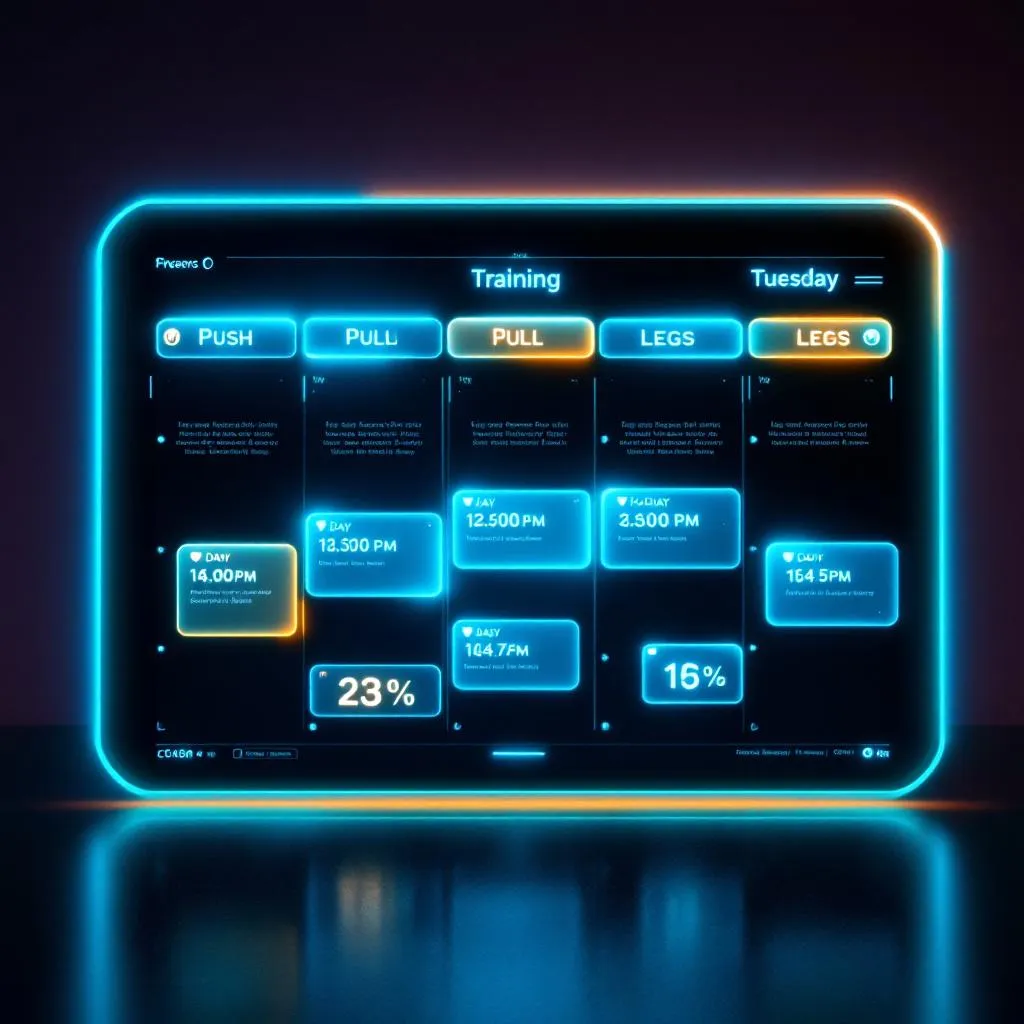
Sample PPL x2 weekly layout:
- Monday: Push
- Tuesday: Pull
- Wednesday: Legs
- Thursday: Push
- Friday: Pull
- Saturday: Legs
- Sunday: Rest
Arnold Split
The Arnold split divides the body into three pairs trained across six sessions: chest/back, shoulders/arms, legs. Unlike PPL, it pairs a push and pull muscle group in the same session (chest and back), which some coaches use to save time through antagonist supersets while others prefer the direct focus of PPL.
The key advantage of the Arnold split is that antagonist pairings (chest with back, for example) create less direct fatigue than training the same muscle group twice in one session — meaning each muscle group gets fresh attention in the pairing while the opposing group rests. For coaches working with physique-oriented athletes who want to bring up lagging body parts, the Arnold split's high per-muscle volume days (chest + back is a long session) can be productive. Use the Arnold split template as a starting structure.
Sample Arnold split weekly layout:
- Monday: Chest + Back
- Tuesday: Shoulders + Arms
- Wednesday: Legs
- Thursday: Chest + Back
- Friday: Shoulders + Arms
- Saturday: Legs
- Sunday: Rest
Upper/Lower x3
Training the upper body three times per week and the lower body three times per week delivers the highest frequency of any mainstream split. Each session contains a full upper or lower body stimulus at moderate per-session volume — typically 6–9 sets per muscle group per session — which accumulates to 18–27 weekly sets. That's at the high end of the productive volume range, making this structure most appropriate for athletes who want to maximize frequency while keeping individual sessions short.
The downside is repetition. Training upper or lower body three consecutive times per week with similar exercise selection can feel monotonous. Coaches using Upper/Lower x3 typically rotate between strength-biased sessions (lower reps, compound movements) and hypertrophy-biased sessions (moderate reps, more isolation work) to maintain athlete engagement and stimulate adaptation through varied loading patterns.
Bro Split — 6-Day Body Part
The traditional bro split assigns one muscle group per day (chest Monday, back Tuesday, legs Wednesday, shoulders Thursday, biceps Friday, triceps Saturday). This structure trains each muscle group only once per week — a significant disadvantage for hypertrophy compared to twice-weekly training at matched volume, according to Schoenfeld et al.'s frequency meta-analysis.
Despite its limitations, the bro split remains popular among competitive bodybuilders who have reached a level of development where per-session specialization volume is genuinely high enough to drive ongoing adaptation. For most athletes, twice-weekly training at equal total volume produces superior results. For coaches working with beginner-to-intermediate clients, bro splits are not recommended for 6-day programs — PPL x2 or Upper/Lower x3 are more appropriate.
Coach tip
When selecting a split for a remote client on a 6-day schedule, consider session length first. PPL sessions run 60–75 minutes for most athletes. Arnold split chest/back sessions often hit 90 minutes. If a client has consistent 60-minute windows, PPL x2 is the most reliable structure. If they have variable availability, Upper/Lower x3 with shorter, denser sessions creates more flexibility.
How to Structure Volume and Recovery on a 6-Day Schedule
The NSCA recommends 10–20 working sets per muscle group per week for hypertrophy, with the lower end of that range appropriate for intermediate trainees and the upper end for advanced athletes with well-established recovery capacity. On a 6-day schedule, that volume distributes across two sessions per muscle group — meaning 5–10 working sets per session per muscle.
Set Distribution by Training Goal
| Goal | Weekly Sets per Muscle | Per Session (2x/week) | Rep Range |
|---|---|---|---|
| Strength focus | 10–12 | 5–6 | 3–6 |
| Hypertrophy focus | 14–18 | 7–9 | 6–12 |
| Mixed strength/hypertrophy | 12–15 | 6–8 | 4–10 |
Starting in the 10–12 weekly set range is appropriate for athletes transitioning from a lower-frequency split. Jumping straight to 18+ sets per muscle group per week at a new training frequency is a reliable path to overreaching. Add 1–2 sets per muscle per week over 3–4 weeks as recovery capacity is confirmed.
Deload Strategy
At 6-day-per-week training, a deload is not optional. Most athletes require a formal deload every 4–6 weeks — a training week where volume drops to 50–60% of normal and intensity is reduced by approximately 10–15% from working weights. Without periodic deloads, fatigue accumulates faster than performance adaptations materialize.
For coaches delivering 6-day programs to remote clients, scheduling deload weeks explicitly in the program — rather than leaving them to athlete initiative — is best practice. Clients rarely deload voluntarily; structured programming removes the guesswork.
Sample 6-Day Gym Workout Schedule
The following is a PPL x2 sample week designed for an intermediate-to-advanced lifter targeting hypertrophy. All exercises use moderate intensity (RPE 7–8) for the main working sets.
| Day | Focus | Key Exercises | Sets × Reps |
|---|---|---|---|
| Monday | Push (Strength) | Barbell bench press, overhead press, dips | 4×4–6 |
| Tuesday | Pull (Strength) | Weighted pull-ups, barbell row, face pulls | 4×4–6 |
| Wednesday | Legs (Strength) | Back squat, Romanian deadlift, leg press | 4×4–6 |
| Thursday | Push (Hypertrophy) | Incline DB press, cable flye, lateral raises, tricep pushdowns | 3–4×8–12 |
| Friday | Pull (Hypertrophy) | Cable row, lat pulldown, DB curl, rear delt flye | 3–4×8–12 |
| Saturday | Legs (Hypertrophy) | Hack squat, walking lunges, leg curl, calf raises | 3–4×8–12 |
| Sunday | Rest | — | — |
The Monday–Wednesday sessions prioritize compound movements at lower rep ranges to build strength. The Thursday–Saturday sessions shift to higher rep ranges with more isolation work to accumulate hypertrophy volume. This strength/hypertrophy pairing within PPL x2 is a common coaching approach that produces both force output improvements and muscle growth over 8–12 week blocks.
Progression Principles for a 6-Day Program
Progression at high training frequency requires deliberate management. The most common mistake is applying linear load progression (add 2.5–5 kg each session) to every exercise across six sessions per week — this works for beginners on 3-day schedules but creates rapid overreaching at higher frequencies.
Double Progression for 6-Day Programs
Double progression — progressing within a rep range before increasing load — works well at 6-day frequency. For an 8–12 rep range, the rule is:
- Start at the lower end (8 reps per set) at a given weight
- Add 1 rep per session until all sets hit 12 reps
- Increase load by the smallest available increment and return to 8 reps
This approach slows the rate of load addition sufficiently to prevent outpacing recovery while maintaining continuous adaptation stimulus. Our guide to workout program design covers progression models for different training goals in detail.
RPE-Based Autoregulation
Rating of Perceived Exertion (RPE) allows athletes to adjust training intensity based on daily readiness rather than hitting fixed loads regardless of fatigue state. On a 6-day schedule, session quality varies significantly — a Thursday push session after three consecutive training days will feel different than Monday's opener. Coaches using RPE targets (e.g., "work up to a set of 5 at RPE 8") give athletes room to train appropriately hard without exceeding their capacity on fatigued days.
For online coaches delivering to remote clients, the online strength coaching platform at IronCoaching supports RPE-based programming with client feedback loops so coaches can monitor session quality across the week.
How Coaches Build 6-Day Programs for Remote Clients
The logistics of building and delivering a 6-day program are more complex than lower-frequency work. Six workout files, exercise libraries, progression notes, and deload schedules need to be coordinated and communicated clearly. For coaches working with multiple clients on 6-day schedules, systemizing program creation is essential.
The most effective approach is template-based programming — building a master 6-day template for each split type (PPL x2, Arnold, Upper/Lower x3) and then customizing exercise selection and loading targets for each client based on their history, goals, and equipment access. This reduces creation time significantly without sacrificing program quality.
When programming for remote clients, consider these delivery principles:
- Progressive volume blocks: Structure programs as 3–4 week volume accumulation phases followed by a deload, not as open-ended weekly routines
- Clear exercise substitutions: Remote clients often lack specific equipment; pre-building swap options prevents athlete confusion
- Check-in frequency: Weekly check-ins at minimum for 6-day clients — fatigue accumulates faster and requires quicker coach intervention than 3–4 day schedules
- Adherence tracking: Monitor which sessions clients are completing; 6-day schedules have inherently lower adherence rates than 4-day, and the data helps coaches identify where athletes are struggling
The IronCoaching Program Builder allows coaches to build complete 6-day programs, set RPE targets, track session completion, and communicate adjustments directly to clients — all within a single platform. For coaches managing more than a handful of remote clients, that workflow consolidation significantly reduces the administrative overhead of high-frequency programming. See how the best workout split for strength guide approaches split selection for different client profiles.
Summary: Best 6-Day Splits at a Glance
| Split | Muscle Group Frequency | Best For | Session Length | Recovery Demand |
|---|---|---|---|---|
| PPL x2 | 2x/week | Intermediate–Advanced hypertrophy | 60–75 min | Moderate |
| Arnold Split | 2x/week | Physique athletes, advanced | 75–90 min | Moderate–High |
| Upper/Lower x3 | 3x/week | Advanced, short sessions | 45–60 min | High |
| Bro Split (6-day) | 1x/week | Advanced bodybuilders only | 60–90 min | Low per muscle |
Frequently Asked Questions
PPL (push pull legs) performed twice per week is the most evidence-supported 6-day schedule for muscle growth. Research published in the JSCR consistently shows that training a muscle group twice per week produces greater hypertrophy than once-weekly training at matched volume, making PPL x2 the top choice for most intermediate and advanced athletes.
Target 10–20 working sets per muscle group per week, distributed across two sessions. That means 5–10 sets per muscle per session. Start at the lower end — around 10–12 weekly sets per muscle — when first transitioning to a 6-day schedule, then add volume gradually over 3–4 weeks as recovery is confirmed.
For beginners and early intermediate lifters with fewer than 18 months of structured training, 6-day schedules typically exceed recovery capacity and produce inferior results to 3–4 day programs. Six days per week is appropriate for intermediate-to-advanced athletes who have plateaued on lower-frequency work and maintain strong sleep, nutrition, and non-training recovery habits.
Yes. A PPL template run twice per week is the most common 6-day structure coaches use with clients. The IronCoaching PPL template provides a ready-built framework — coaches can customize exercise selection, loading schemes, and rep ranges for individual athletes while keeping the proven PPL structure intact.
One rest day per week is built into every 6-day schedule. Most athletes take Sunday as their rest day, though positioning the rest day mid-week (Wednesday or Thursday) can help manage cumulative fatigue in some schedules. For athletes in high-stress periods — travel, work deadlines, poor sleep — extending to two rest days in a given week is appropriate and does not compromise long-term progress.
Run a 6-day schedule for 8–12 weeks before a structured reassessment and deload. Include a formal deload week every 4–6 weeks within the phase. After the full phase, evaluating whether higher-frequency training continues to be productive — or whether transitioning to a lower-frequency strength block would provide a novel stimulus — is standard periodization practice.
Both are 6-day schedules that train each muscle group twice per week, but they structure sessions differently. PPL separates push, pull, and leg movements into distinct sessions. The Arnold split pairs antagonist muscle groups (chest with back, shoulders with arms) in the same session. PPL typically produces cleaner volume distribution per muscle; the Arnold split allows antagonist supersets and can appeal to athletes who prefer paired-muscle sessions.
Sources & References
- Journal of Strength and Conditioning Research — Schoenfeld BJ et al., "Effects of Resistance Training Frequency on Measures of Muscle Hypertrophy: A Systematic Review and Meta-Analysis" — twice-weekly training produces significantly greater hypertrophy than once-weekly at matched volume (2016)
- NSCA — National Strength and Conditioning Association resistance training volume guidelines — 10–20 working sets per muscle group per week for hypertrophy in advanced trainees
- ACSM — American College of Sports Medicine Position Stand on resistance training — protein requirements (1.6–2.2g/kg/day) and frequency recommendations for muscle hypertrophy (2022)