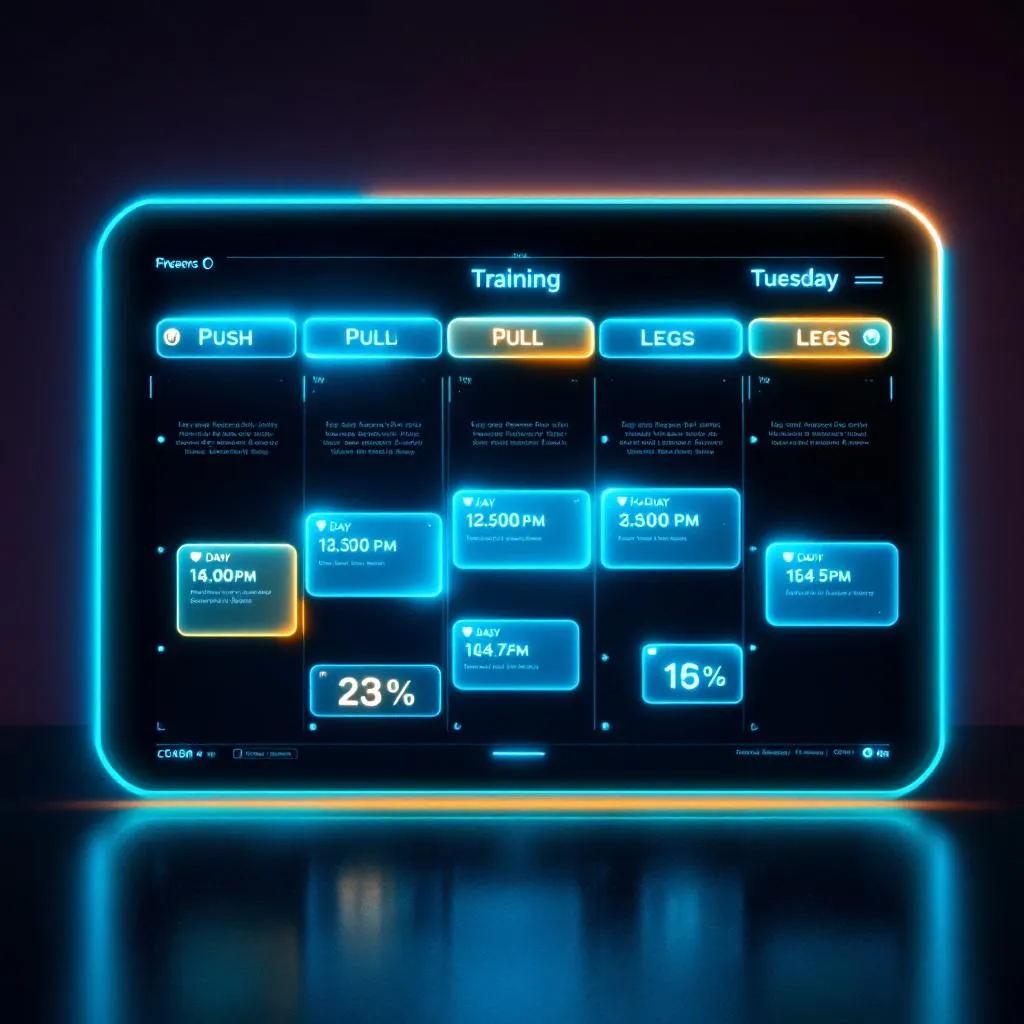
The push pull legs (PPL) routine is one of the most widely used training frameworks for intermediate and advanced lifters. It divides weekly training into three session types: push days (chest, shoulders, triceps), pull days (back, biceps), and leg days (quads, hamstrings, glutes). The logic is straightforward — muscles involved in pressing movements recover together, as do those involved in pulling, so grouping them reduces overlap and allows higher volume per session without interference between muscle groups.
PPL sits between upper/lower splits and body-part splits in terms of frequency and specialization. Unlike a bro split (one muscle group per day), PPL achieves twice-weekly muscle group training in the 6-day variant. Unlike full-body routines, it allows deeper specialization per session. That middle ground is why PPL has remained the dominant intermediate training structure for decades.
Key Takeaways
- PPL runs as 3-day, 4-day, or 6-day schedules — the 6-day variant trains each muscle group twice per week
- Push days target chest, shoulders, and triceps; pull days target back and biceps; leg days target the entire lower body
- A 2016 meta-analysis by Schoenfeld et al. found twice-weekly training frequency produces significantly greater hypertrophy than once-weekly at equal volume
- Linear progression on compound lifts plus a structured 4-week mesocycle drives consistent progress in PPL
- Coaches can build and deliver PPL templates systematically using IronCoaching's Program Builder, tracking compliance by session type
What Is the Push Pull Legs Routine?
The push pull legs routine organizes training sessions by the primary movement pattern used, not by individual muscle groups. Push sessions train all muscles involved in pressing movements — chest, anterior deltoids, and triceps. Pull sessions train all muscles involved in rowing and pulling movements — lats, traps, rhomboids, rear deltoids, and biceps. Leg sessions cover the entire lower body — quads, hamstrings, glutes, and calves.
This grouping creates natural recovery synergy. When you bench press on Monday, your chest, front delts, and triceps all work and then recover together. When you row on Tuesday, those pushing muscles rest while the back and biceps take the stimulus. Compared to a random muscle group split, PPL minimizes the risk of one session impairing the next because the working muscles on any given day have at least 48 hours of recovery before they're loaded again.
PPL became popular among intermediate lifters because it solves a common problem: as athletes advance, the volume needed to drive progress exceeds what a single weekly session per muscle group can support. A 2016 meta-analysis by Schoenfeld, Ogborn, and Krieger published in the Journal of Strength and Conditioning Research analyzed 10 studies and found that training each muscle group twice per week produced significantly greater hypertrophy than once per week with equivalent total volume — likely because muscle protein synthesis (which peaks at 24-48 hours post-training) can be stimulated more frequently.
PPL is best suited for lifters with 12-24 months of consistent training experience. Beginners lack the work capacity and motor pattern development to benefit from 5-6 training days. Most coaches using online strength coaching introduce PPL when an athlete has outgrown upper/lower splits and consistently trains 4-5 days per week.
3-Day, 4-Day, and 6-Day PPL Variations
PPL adapts to different training frequencies. The right variant depends on an athlete's available days, recovery capacity, and whether hypertrophy or strength is the primary goal.
3-Day PPL: One push, one pull, and one leg session per week. Each muscle group is trained once per week at higher per-session volume. This works for lifters with severe schedule constraints, but it's sub-optimal for hypertrophy. With muscle protein synthesis dissipating fully by 72 hours post-training, a 3-day PPL leaves 4 days where no growth stimulus exists for any given muscle group. Most intermediate lifters would achieve better hypertrophy on a 3-day upper/lower or full-body program, which provides higher frequency with the same number of training days.
4-Day PPL: One full PPL cycle plus a fourth session targeting a lagging area. The most common structures are Push/Pull/Legs/Push (extra pressing volume for chest and shoulder development) and Push/Pull/Legs/Pull (extra pulling volume for back development). This allows asymmetric prioritization without committing to a full 6-day schedule. Experienced coaches use 4-day PPL variants during phases where an athlete needs to bring up a weak point.
6-Day PPL: Two full PPL cycles per week, typically structured as Push A/Pull A/Legs A/Push B/Pull B/Legs B. This is the most popular intermediate PPL variant and the one most commonly described when people refer to "PPL." Each muscle group is trained twice per week, which aligns with the NSCA's recommendations for optimal hypertrophy frequency. The A and B sessions differ in exercise selection to avoid exact repetition while training the same movement patterns.
Matching PPL variant to athlete profile
3-day PPL suits athletes maintaining muscle with limited availability. 4-day suits those with one muscle group lagging. 6-day suits intermediate-to-advanced athletes focused on hypertrophy with reliable 5-6 day availability.
Push Day: Exercise Selection and Structure
A push day covers three functional categories: horizontal pressing (chest-dominant), vertical/overhead pressing (shoulder-dominant), and triceps isolation. The session structure follows compound movements first, isolation work last — this ordering is recommended by the American College of Sports Medicine for maximizing force output on primary movements before fatigue accumulates.
Horizontal pressing: Barbell bench press (flat or incline) is the standard primary push day movement. Barbell bench allows the most consistent load progression and produces the highest pec and anterior deltoid activation. Most coaches program flat bench as the primary movement in Push A and incline bench or incline dumbbell press as the primary in Push B to vary the stimulus.
Overhead pressing: Barbell overhead press or seated dumbbell press develops the medial and anterior deltoids specifically, which are undertrained by horizontal pressing alone. Overhead press also recruits the upper traps and stabilizers not engaged during bench.
Lateral raises: Cable or dumbbell lateral raises target the medial deltoid — the muscle that gives shoulders their width. These belong in every push session as a high-rep isolation movement (15-20 reps).
Triceps isolation: Close-grip bench, skull crushers, or cable pushdowns target the triceps through a fuller range of motion than compound pressing alone provides. Program one triceps isolation exercise per push session.
Sample Push Day A (strength emphasis):
| Exercise | Sets | Reps | Rest |
|---|---|---|---|
| Barbell Bench Press | 4 | 4-6 | 3 min |
| Overhead Press | 3 | 6-8 | 2 min |
| Incline Dumbbell Press | 3 | 10-12 | 90 sec |
| Lateral Raises | 3 | 15-20 | 60 sec |
| Triceps Pushdown | 3 | 12-15 | 60 sec |
Sample Push Day B (volume/hypertrophy emphasis):
| Exercise | Sets | Reps | Rest |
|---|---|---|---|
| Incline Barbell Press | 4 | 6-8 | 2 min |
| Seated Dumbbell Shoulder Press | 3 | 10-12 | 90 sec |
| Cable Fly | 3 | 12-15 | 60 sec |
| Lateral Raises | 3 | 15-20 | 60 sec |
| Overhead Triceps Extension | 3 | 12-15 | 60 sec |
You can access a pre-built push pull legs template or build your own Push A/Push B variants using IronCoaching's Program Builder, which lets you create reusable templates and assign them to specific athletes.
Pull Day: Exercise Selection and Structure
A pull day covers vertical pulling (lat-focused), horizontal pulling (upper-back focused), rear deltoid development, and biceps isolation. The pull session has the highest exercise diversity of the three PPL days because the back is a complex muscle group requiring different angles to develop fully.
Vertical pulling: Pull-ups (bodyweight or weighted) or lat pulldown. Pull-ups are the gold standard vertical pull movement and should be weighted once an athlete can perform 10+ bodyweight reps. For athletes not yet at that threshold, lat pulldown is the appropriate substitution. Vertical pulling primarily develops the lats through their full range of motion.
Horizontal pulling: Barbell rows, dumbbell rows, or cable rows. Horizontal pulling develops the middle and upper back — rhomboids, mid-traps, and the thickness of the lats. Research published in the Journal of Strength and Conditioning Research consistently identifies compound rowing as the most effective exercise class for upper-back development. Program at least one heavy barbell or dumbbell row per pull session before cable alternatives.
Rear deltoid work: Face pulls, reverse pec deck, or rear delt flyes. The rear deltoid is the most undertrained upper-body muscle in typical gym programs. Deficient rear delts contribute to rounded shoulders and anterior shoulder impingement — a common overuse issue in heavy pushers. Include 3 sets of 15-20 reps every pull session.
Biceps isolation: Barbell curls, dumbbell curls, hammer curls, or cable curls. Since biceps are pre-fatigued by pull-up and rowing work, keep biceps volume moderate (2-3 sets) and program it last.
Sample Pull Day:
| Exercise | Sets | Reps | Rest |
|---|---|---|---|
| Weighted Pull-ups | 4 | 5-7 | 3 min |
| Barbell Row | 4 | 6-8 | 2 min |
| Seated Cable Row | 3 | 10-12 | 90 sec |
| Face Pulls | 3 | 15-20 | 60 sec |
| Barbell Curl | 3 | 10-12 | 60 sec |
| Hammer Curl | 2 | 12-15 | 60 sec |
Leg Day: Exercise Selection and Structure
Leg day covers squat-pattern movements (quad-dominant), hip-hinge movements (posterior-chain dominant), and isolation work for quads, hamstrings, and calves. Many intermediate lifters underinvest in leg training, which limits total development — lower-body training drives systemic adaptations that benefit the entire body.
Quad-dominant compound: Back squat is the standard primary leg day movement. Front squat, goblet squat, or leg press work as alternatives or secondary movements. Squats should be programmed first in the session when strength levels are highest. Research by Ronnestad et al. found that integrating leg training with upper-body training produces superior hormonal responses compared to upper-body training in isolation — a systemic benefit of maintaining high leg day commitment.
Hip-hinge: Romanian deadlift (RDL) or stiff-leg deadlift for hamstring development. Conventional deadlifts can be programmed on leg day (more posterior-chain focus) or pull day (more lat and upper-back focus) — this is a coach's preference call, but avoid deadlifting the day after a heavy squat session to protect lower back recovery.
Leg isolation: Leg press (as a secondary quad movement after squats), leg curls (lying or seated), leg extensions, and calf raises. These movements allow additional volume on specific muscles that may be underdeveloped relative to the compound lifts.
Sample Leg Day:
| Exercise | Sets | Reps | Rest |
|---|---|---|---|
| Back Squat | 4 | 5-6 | 3 min |
| Romanian Deadlift | 4 | 8-10 | 2 min |
| Leg Press | 3 | 10-12 | 90 sec |
| Lying Leg Curl | 3 | 12-15 | 60 sec |
| Leg Extension | 3 | 12-15 | 60 sec |
| Standing Calf Raises | 4 | 15-20 | 60 sec |
How to Structure Your PPL Week
Rest day placement matters as much as session design. The general rule: never schedule pull day immediately after push day without adequate recovery — triceps are used in both sessions (as stabilizers in pull movements), and fatigued triceps limit overhead pressing performance. Push-rest-pull or Push/Pull/Rest/Legs arrangements avoid this issue.
3-Day PPL (Mon/Wed/Fri):
| Mon | Tue | Wed | Thu | Fri | Sat | Sun |
|---|---|---|---|---|---|---|
| Push | Rest | Pull | Rest | Legs | Rest | Rest |
4-Day PPL (Mon/Tue/Thu/Fri):
| Mon | Tue | Wed | Thu | Fri | Sat | Sun |
|---|---|---|---|---|---|---|
| Push | Pull | Rest | Legs | Push | Rest | Rest |
6-Day PPL (Mon-Sat):
| Mon | Tue | Wed | Thu | Fri | Sat | Sun |
|---|---|---|---|---|---|---|
| Push A | Pull A | Legs A | Push B | Pull B | Legs B | Rest |
The 6-day schedule gives Sunday as a mandatory rest day. Some athletes add a second rest day by moving Legs B to Sunday — this works, but note that the fatigue management of the full 6-day schedule is higher than most other splits. For a full breakdown of how to structure a 6-day training week — including volume targets, deload strategy, and alternatives like the Arnold split — see the complete 6-day gym workout schedule guide. Compare the tradeoffs of different split structures in the best workout split for strength guide.
How to Progress in a PPL Program
Progression in PPL follows two tracks: linear load progression on primary compound lifts, and structured volume progression on secondary and isolation work.
For primary compound lifts (bench press, overhead press, barbell row, squat, RDL), use a simple progression rule: when you hit the top of your target rep range across all working sets, add 2.5-5kg at the next session. If you're aiming for 4×5 on bench and you hit 4×5 at a given weight, load 2.5kg more next session. This is the same model described in the progressive overload training guide and forms the backbone of any effective strength program.
When linear progression stalls (no increase in 2-3 sessions), move to a weekly progression model: add one rep per set rather than adding weight, cycling through a rep range (e.g., 4×5 → 4×6 → 4×7, then reload heavier and repeat).
For secondary and isolation work, RPE-based progression is more practical. Aim for RPE 7-8 on working sets. Add reps, add a set, or add weight over a 4-6 week mesocycle, then deload.
Recommended 4-week PPL mesocycle:
| Week | Primary Compounds | Secondary Movements | Volume |
|---|---|---|---|
| 1 (Accumulation) | 4×5 @ RPE 7 | 3×10 @ RPE 6 | Moderate |
| 2 (Build) | 4×5 @ RPE 8 | 3×10 @ RPE 7 | Moderate-high |
| 3 (Peak) | 5×5 @ RPE 8-9 | 3×12 @ RPE 8 | High |
| 4 (Deload) | 3×5 @ RPE 5-6 | 2×8 @ RPE 5 | Low (40% reduction) |
After the deload, begin the next mesocycle with slightly higher starting loads than the previous cycle. This undulating structure is detailed in the Coach's Guide to Workout Program Design.
Programming PPL for Coaching Clients
Delivering PPL to coaching clients requires more than sending a template. The most effective coaches track three metrics to assess whether a PPL program is working as intended.
Session completion by type: Coaches using IronCoaching can see which session types clients complete and which they skip. If a client on 6-day PPL consistently completes push and pull sessions but skips legs, that's actionable data — adjust the program or address the compliance issue directly. Leg compliance is the most common PPL dropout pattern.
Compound lift trajectory: Plot each client's primary lift performance (bench, squat, row) across the mesocycle. A flat trajectory after week 2 signals a programming problem — check if the volume is too high, recovery is compromised, or the starting loads were too ambitious. Stalls caught early prevent wasted training blocks.
Session timing and spacing: If a client logs Push A on Monday at 8pm and Pull A on Tuesday at 6am, they have less than 10 hours of recovery. Flag this pattern. Adequate spacing between sessions (at least 24 hours) significantly affects performance quality on the next session.
Not every client suits PPL. The client's training history, available days, and primary goal all factor into split selection. Use this table to guide the decision:
| Factor | Full Body 3x | Upper/Lower 4-Day | 6-Day PPL |
|---|---|---|---|
| Recommended experience | Beginner | Beginner–Intermediate | Intermediate–Advanced |
| Weekly days required | 3 | 4 | 5-6 |
| Muscle group frequency | 3× per week | 2× per week | 2× per week |
| Per-session length | 75-90 min | 60-75 min | 50-65 min |
| Hypertrophy suitability | ★★★ | ★★★★ | ★★★★★ |
| Strength suitability | ★★★★ | ★★★★★ | ★★★ |
| Recovery demand | Low | Moderate | High |
| Best use case | New lifters building base | Most intermediate lifters | Advanced hypertrophy focus |
For athletes with a powerlifting focus, PPL is rarely the optimal choice. Squat, bench, and deadlift appear only once per week in a standard PPL, which is low frequency for competition lifts. The powerlifting program design guide covers frequency structures that better serve strength sport preparation, where each competition lift needs 2-3 weekly exposures.
For clients who need the full-body-3x template or the upper lower split instead of PPL, the progression logic is the same — what changes is frequency and per-session volume distribution.
Frequently Asked Questions
The push pull legs routine divides training into three session types based on movement patterns: push days train chest, shoulders, and triceps; pull days train back and biceps; leg days train the entire lower body. Grouping muscles by shared movement creates natural recovery overlap between sessions.
PPL runs on 3, 4, or 6 days per week. The 3-day version trains each muscle group once per week. The 6-day version (full PPL cycle repeated twice) trains each muscle group twice per week, which research supports as the optimal frequency for hypertrophy.
PPL is not recommended for beginners. Lifters in their first 12 months of training develop better on full-body routines that train each movement pattern 3 times per week, which accelerates motor learning and provides higher frequency stimulus with less per-session volume. PPL suits athletes who have outgrown a full-body or upper/lower program.
Yes, but PPL favors hypertrophy over pure strength development. In a 3-day PPL, each competition lift (squat, bench, deadlift) appears once per week — lower frequency than most effective strength programs. The 6-day PPL brings each lift to twice weekly, which is more competitive for strength, though dedicated powerlifting programs maintain higher specificity.
The flat or incline barbell bench press is the primary push day movement for most lifters. It provides the best combination of load potential, muscle recruitment across chest, anterior deltoid, and triceps, and long-term progressive potential. Overhead press is the essential second compound on every push day.
PPL sessions typically run 50-75 minutes with 5-6 exercises and appropriate rest periods — 2-3 minutes for compound lifts, 60-90 seconds for isolation work. Sessions in the 6-day PPL tend to run shorter than 3-day variants because volume is distributed across more sessions per muscle group.
Deadlifts can appear on either day depending on programming goals. Romanian deadlifts belong on leg day for hamstring focus. Conventional deadlifts can go on pull day for upper-back and lat emphasis, or on leg day for posterior chain work. Avoid heavy deadlifts the day after a heavy squat session — back-to-back loading of the lower-back musculature impairs recovery.
Six days gives you the best results — two full cycles per week means each muscle group trains twice, which aligns with research on optimal hypertrophy frequency. If you can only commit to 3 days, PPL works but upper/lower or full-body programs typically produce better results at that frequency. Four days is a solid middle ground for lifters who want higher volume without a 6-day commitment.
PPL is not recommended for beginners. In your first 6-12 months of training, full-body routines 3 times per week drive faster progress because you're practicing every movement pattern more frequently. PPL's strength is volume accumulation per muscle group, which only becomes a limiting factor once you've built a solid base. Most coaches introduce PPL after an athlete has 12-24 months of consistent training experience.
For strength-focused athletes, a 4-day PPL variant works well — for example Push/Pull/Legs/Pull to add extra deadlift and row volume. You can also run a 6-day PPL with strength-biased exercise selection (lower rep ranges of 3-6 on compounds, more rest). Pure powerlifting programs keep squat, bench, and deadlift at 2-3 exposures per week, which PPL in its standard form doesn't achieve. Use IronCoaching's Program Builder to customize rep ranges and session structure to your athlete's strength goals.
Yes, and it works — one push, pull, and leg session per week. The tradeoff is lower muscle group frequency (once per week per group), which is sub-optimal for hypertrophy compared to the 6-day variant. If you're limited to 3 days, a full-body program or upper/lower split will likely produce better results. 3-day PPL is best suited for athletes maintaining muscle during a busy period rather than actively trying to build.
A typical PPL session runs 50-70 minutes with 5-6 exercises and appropriate rest periods: 2-3 minutes for heavy compounds and 60-90 seconds for isolation work. The 6-day version tends to run shorter than 3-day variants because volume is spread across more sessions. Sessions go long when athletes underestimate rest periods on compound lifts — respect the rest, and you'll stay within the target window.
Sources & References
- Schoenfeld BJ, Ogborn D, Krieger JW — "Effects of Resistance Training Frequency on Measures of Muscle Hypertrophy: A Systematic Review and Meta-Analysis" — Journal of Strength and Conditioning Research (2016)
- NSCA — "Training Frequency for Muscle Hypertrophy" — National Strength and Conditioning Association
- Ronnestad BR, Nygaard H, Raastad T — "Physiological elevation of endogenous hormones results in superior strength training adaptation" — European Journal of Applied Physiology (2011)
- ACSM — Resistance Training Position Stand — American College of Sports Medicine (2009)
- Journal of Strength and Conditioning Research — Peer-reviewed research on training frequency, volume, and exercise selection effectiveness