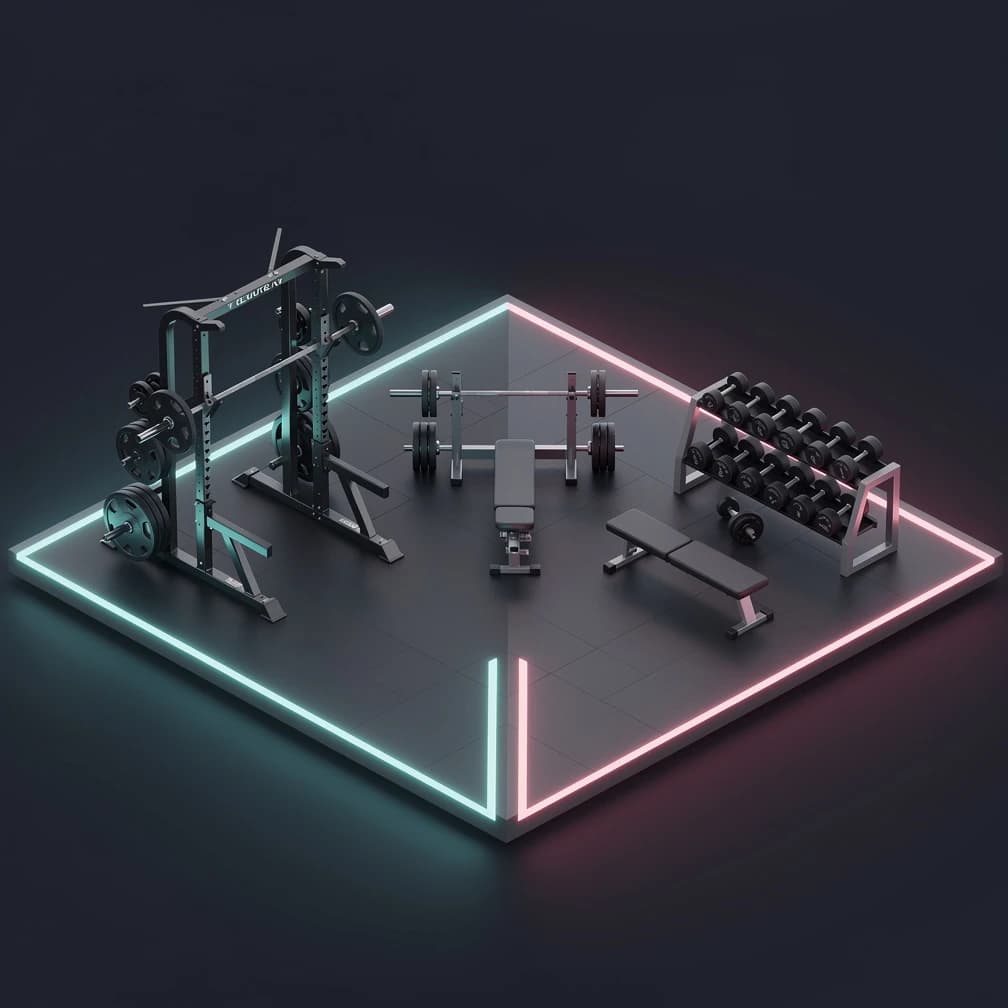
There are eight primary types of workouts that cover almost every reason someone steps into a gym: strength training, hypertrophy training, powerlifting, Olympic lifting, cardiovascular training, high-intensity interval training (HIIT), functional fitness, and mobility work. Each one produces distinct physiological adaptations, follows different programming rules, and answers a different question about why you are training. Most lifters benefit from combining two or three of them rather than choosing one — but the combination matters, because not all workout types coexist easily.
This guide breaks down what each type actually does, who it is for, how to choose between them, and how coaches integrate multiple types into a single coherent programme.
Key Takeaways
- The eight main types of workouts each produce different adaptations: strength, hypertrophy, power, cardiovascular endurance, anaerobic capacity, motor control, and mobility
- Strength training (1–6 reps, heavy) and hypertrophy training (6–15 reps, moderate) are the two most common templates and the foundation for nearly every other type
- Most goals are best served by combining a primary type (3–4 sessions per week) with a secondary type (1–2 sessions per week) rather than focusing on one exclusively
- Concurrent training — combining strength and endurance — works when sessions are properly spaced and volume is managed, but poorly programmed concurrent training blunts both adaptations
- Beginners should start with full-body strength or hypertrophy training before adding specialisation
- Coaches choose workout types based on the client's primary goal, training age, recovery capacity, and how much weekly time the client has — not on what is trending
The 8 Main Types of Workouts
Every formal training programme falls into one of these eight categories, or combines several of them. The distinctions matter because each type is structured around a different physiological target — and trying to chase two incompatible adaptations in the same session usually means you achieve neither.
1. Strength Training
Strength training builds the ability to produce maximal force, primarily by recruiting more muscle fibres and improving the nervous system's coordination of contractions. The classical strength template uses compound barbell lifts — squat, bench press, deadlift, overhead press, row — programmed in the 1–6 rep range at 80–95% of one-rep maximum, with long rest periods (3–5 minutes) between sets.
A typical session targets 2–4 main lifts, with 3–6 working sets per lift. Volume per session is moderate; intensity is high. Sample structure for a strength-focused session:
- Squat — 4 sets of 5 reps at 80%
- Bench press — 4 sets of 5 reps at 80%
- Barbell row — 3 sets of 6 reps at 75%
- Accessory work — 2–3 isolation movements, 3 sets of 8–12
Templates like the 5x5 workout programme and Wendler's 5/3/1 programme are classic strength training implementations. Strength training suits anyone whose primary goal is force production, sport performance, or who simply wants to be measurably stronger. It is also the foundation underneath hypertrophy training — you cannot lift heavy enough volume to maximise muscle growth without a baseline of strength. The strength training equipment guide covers the barbell, rack, and accessory tools that make this workout type possible, with budget tiers for home gym and coaching facility setups. For a deeper breakdown of resistance training as the broader category — all five modalities, health benefits, and how strength and hypertrophy fit within it — see the complete resistance training guide.
2. Hypertrophy Training
Hypertrophy training builds muscle size. The mechanism is mechanical tension applied repeatedly across a high volume of sets, taken close to failure. The defining variables are rep range (6–15 reps is the optimal zone for most), proximity to failure (within 0–3 reps in reserve), and weekly volume per muscle group (10–20 working sets per muscle per week for most intermediates).
Hypertrophy training tolerates — and benefits from — more isolation work than strength training, and exercise selection broadens to include cables, machines, dumbbells, and bodyweight movements alongside the compound barbell lifts. Splits like push/pull/legs are the standard organisational structure, because they let you accumulate higher weekly volume per muscle group than full-body training allows.
A typical hypertrophy session targets 1–2 muscle groups with 4–6 exercises, 3–4 sets each, 8–12 reps per set, 60–90 second rest. The contrast with strength training is clear: shorter rest, higher rep range, more total sets, more isolation work. The dedicated hypertrophy versus strength comparison covers the physiology in detail.
Hypertrophy training is the right type for anyone whose goal is muscle growth, body recomposition, or improving the visual aesthetics of training. Bodybuilders, physique competitors, and most recreational lifters who want to look stronger choose hypertrophy as the primary type.
3. Powerlifting Training
Powerlifting is a specialisation of strength training built around three competition lifts: the back squat, bench press, and deadlift. The goal is to maximise the one-rep maximum on each of these three lifts.
Where general strength training distributes volume across many movement patterns, powerlifting programming concentrates volume on the specific three lifts and their close variations (paused bench, deficit deadlift, pause squat, board press). The intensity is higher and more frequent — competitive powerlifters routinely train at 85–95% of 1RM on competition lifts 2–4 times per week.
Powerlifting programmes use periodisation to manage fatigue across blocks: accumulation phases build volume at submaximal intensity, intensification phases reduce volume and ramp intensity toward competition lifts, and a deload-and-peak phase prepares for a meet. The powerlifting programme design guide covers periodisation models, block structure, accessory work, and meet preparation.
Powerlifting suits competitive lifters and any general lifter whose primary goal is squat, bench, and deadlift numbers. It is not the best choice for muscle growth as a primary goal, for athletic performance, or for general fitness — the high specificity narrows the adaptation.
4. Olympic Weightlifting
Olympic weightlifting trains two competition lifts: the snatch (barbell from floor to overhead in one motion) and the clean and jerk (floor to shoulders, then shoulders to overhead). These are technical, explosive lifts requiring high power output, mobility, and coordination.
The training is unlike any other strength type because the lifts themselves are skill movements. Sessions involve extensive technical work at moderate weights (60–80% of 1RM), accessory strength work (front squats, back squats, pulls), and dedicated mobility work for the overhead position and deep squat. Volume per session is lower than powerlifting because the central nervous system fatigue from explosive lifting is high.
Olympic lifting builds power, mobility, posterior chain strength, and athletic transferability that most other lifting types do not produce. It suits competitive Olympic weightlifters, athletes whose sport demands rapid force production (rugby, American football, track and field throws), and lifters who want a deep skill challenge in their training.
The cost is a long learning curve — most lifters need a year of consistent practice before the lifts become reliably technical, and serious progress usually requires a qualified coach.
5. Cardiovascular Training (Endurance)
Cardiovascular training builds the body's ability to deliver oxygen to working muscles over sustained effort. The primary adaptations are improved heart stroke volume, capillary density, mitochondrial density in muscle cells, and aerobic enzyme activity.
Steady-state cardio (zone 2 work) is the dominant template: 30–60 minutes of continuous effort at 60–75% of maximum heart rate, where conversation is possible but slightly laboured. Running, cycling, rowing, and swimming are the standard modalities. More structured endurance training adds tempo work, threshold intervals, and longer aerobic sessions on a periodised schedule.
Cardiovascular training is the right type for anyone training for endurance events (marathons, triathlons, cycling), for general cardiovascular health (the ACSM recommends 150 minutes of moderate aerobic activity per week for healthy adults), and as a secondary type for lifters who want better recovery between sets and improved work capacity in the gym.
The trade-off, which the concurrent training section below covers, is that high-volume endurance training competes with strength and hypertrophy adaptations if poorly programmed.
6. High-Intensity Interval Training (HIIT)
HIIT alternates short bursts of near-maximal effort with brief recovery periods. The classical structure is 20–60 seconds of high-intensity work followed by 1–2 minutes of low-intensity recovery, repeated 6–12 times for a total session of 15–30 minutes.
HIIT produces adaptations in both the aerobic and anaerobic energy systems. It improves VO2 max, lactate threshold, and anaerobic capacity in less total time than steady-state cardio — making it appealing to anyone with limited training time. The most common modalities are bike sprints, rowing, treadmill running, kettlebell circuits, or bodyweight EMOM (every minute on the minute) work.
HIIT suits lifters who want efficient cardiovascular development without long endurance sessions, anyone short on time, and clients whose goals are fat loss or general conditioning rather than maximum strength or size. The limitation is that HIIT is genuinely high-intensity — two to three sessions per week is the upper limit for most people before fatigue accumulates and interferes with strength training.
7. Functional Fitness and CrossFit
Functional fitness — most visibly represented by CrossFit — blends strength training, Olympic lifting, gymnastics, and conditioning into a single training style. Sessions typically include a strength or skill component followed by a metabolic conditioning workout ("WOD" in CrossFit terminology) combining weightlifting, bodyweight movements, and conditioning equipment under time pressure.
The adaptation target is breadth: strength, power, endurance, agility, and motor control simultaneously. The trade-off is depth — a functional fitness practitioner will not match a specialised powerlifter on max strength, a marathoner on aerobic capacity, or a bodybuilder on hypertrophy, but will outperform any single specialist across the full range.
Functional fitness suits general-population athletes, military and tactical personnel, anyone who wants varied training that combines lifting with conditioning, and clients who find traditional bodybuilding-style training boring. It is not the right primary type for anyone whose goal is a specific outcome that needs specialisation.
8. Mobility and Flexibility Training
Mobility training develops the active range of motion at joints. Where stretching passively lengthens muscles, mobility training combines active range work, end-range strength, and joint-specific control drills — typically including hip openers, shoulder dislocates, thoracic spine rotations, ankle drills, and controlled articular rotations (CARs).
Sessions can range from 10 minutes of daily maintenance work to dedicated 45-minute mobility sessions. The most evidence-supported modalities are end-range isometric work, dynamic range drills (rather than static stretches held for minutes), and loaded stretching where the muscle is challenged at its end range.
Mobility training is the right type for anyone whose lifting is limited by joint range (poor squat depth, restricted overhead position), older lifters where joint health is the primary concern, athletes whose sport demands range (martial arts, gymnastics, climbing), and as a maintenance type alongside any other primary training.
It is rarely the sole type for a programme — but a complete training week almost always includes at least 30–60 minutes of dedicated mobility work.
Strength, Hypertrophy, and Endurance: The Three Core Adaptations
Behind the eight workout types sit three fundamental physiological adaptations. Understanding them clarifies why certain workout types pair well and others conflict.
These adaptations are not strictly exclusive — most workouts produce some of each, but the dominant adaptation depends on which variables are emphasised. A strength training programme produces some hypertrophy as a byproduct; a hypertrophy programme produces some strength gain. The pure forms in the table above are the templates, not the only possible expressions.
The clearer your primary adaptation target, the more rigorously you can structure the programme around it. The hypertrophy-versus-strength comparison covers the strength–hypertrophy distinction in more detail, including how to combine the two in a single programme.
How to Choose the Right Type for Your Goal
The right workout type is the one whose primary adaptation matches your primary outcome. Most goals decompose into a primary type and a secondary type, where the secondary supports the primary without competing with it.
If you are a beginner with no clear competitive goal, the highest-leverage type is full-body strength or hypertrophy training, three sessions per week. This builds the foundation underneath every other adaptation and produces the broadest base for specialisation later. The how-to-create-a-workout-programme guide covers what that looks like in practice.
Combining Types: Concurrent and Hybrid Training
The interesting question is not which single type to choose — it is which combinations work, and which conflict. The research term for this is concurrent training, and it describes the simultaneous training of strength and endurance.
The interference effect is real but often overstated. Wilson and colleagues' meta-analysis on concurrent training found that endurance training does blunt strength and hypertrophy gains when total endurance volume is high, when endurance sessions are scheduled close to lifting sessions, and when the endurance modality is high-impact (running) rather than low-impact (cycling). When concurrent training is properly programmed, the interference is small enough that most lifters can comfortably hold both adaptations.
Best practices for combining types:
- Separate sessions by at least 6 hours when training both strength and endurance on the same day. Lift in the morning, run in the evening (or vice versa).
- Prioritise the dominant adaptation. If strength is primary, place strength sessions first in the week and on the most rested days; let endurance sessions follow.
- Keep secondary-type volume modest. Two endurance sessions per week of 30–45 minutes is plenty alongside a strength programme. Five endurance sessions starts to compete.
- Prefer cycling, rowing, or swimming over running for secondary cardiovascular training when strength is primary — lower-impact modalities interfere less with lower-body recovery.
- Build conditioning in blocks rather than year-round. Concurrent training works best when one adaptation is the focus per block, with the other in maintenance.
Modern hybrid athletes — lifters who also run marathons, compete in CrossFit, or train for tactical performance — succeed by managing exactly these variables. The strength training periodisation guide covers how to sequence training blocks so that conflicting adaptations are pursued in different phases rather than all at once.
Sample Weekly Schedules by Goal
Three concrete examples of how to combine workout types over a training week.
Example 1 — Strength and Size Focus (4 sessions per week)
- Monday — Lower body strength. Squat 4x5 at 80%, deficit deadlift 3x5, front squat 3x6, accessory leg work
- Tuesday — Upper push hypertrophy. Bench press 4x6, incline dumbbell press 4x10, overhead press 3x8, triceps + chest isolation
- Thursday — Lower body hypertrophy. Romanian deadlift 4x8, Bulgarian split squat 3x10, leg curl 4x12, calves
- Friday — Upper pull hypertrophy. Barbell row 4x8, pull-up 4x6–8, cable row 3x12, biceps + rear delt isolation
- Daily — 10 minutes mobility. Hip openers, thoracic spine work, shoulder maintenance
This template combines strength training (Monday, Tuesday's compound work) with hypertrophy training (the higher-rep accessory work and Thursday/Friday volume). Cardio is optional — 20 minutes of zone-2 work twice a week on off days if fat loss or conditioning is also a goal. The 4-day workout split programme is built on exactly this structure.
Example 2 — General Fitness and Health (5 sessions per week)
- Monday — Full body lift. Squat or deadlift, bench or overhead press, row, one accessory pair
- Tuesday — Zone 2 cardio. 35 minutes cycling or rowing at conversational pace
- Wednesday — Full body lift. Different lift selection, slightly higher volume
- Friday — Full body lift. Lighter session, more accessory, finishing with mobility
- Saturday — Zone 2 cardio + mobility. 45 minutes cycling, then 15 minutes mobility
- Daily — 5–10 minutes mobility maintenance
This is the template for the broadest possible general fitness — strength training as the primary, cardio twice a week, mobility daily. It hits the ACSM physical activity guidelines, develops both strength and cardiovascular health, and is sustainable indefinitely. The full-body workout plan covers the lift days in detail.
Example 3 — Hybrid Athletic (6 sessions per week)
- Monday — Strength lower. Squat heavy, posterior chain accessories
- Tuesday — Long run. 60 minutes easy aerobic
- Wednesday — Strength upper. Press + pull main work, accessory
- Thursday — Tempo run or threshold intervals. 30–40 minutes
- Friday — Strength full body. Lighter, technique-focused, power work (jumps, throws)
- Saturday — Long aerobic. 60–90 minutes run or cycle
- Sunday — Mobility and recovery. Full 30 minutes
This is for the lifter who also wants serious cardiovascular fitness — capable of running a half marathon while maintaining a strong squat and bench. It demands more recovery management than either pure strength or pure endurance, and works best when one adaptation is prioritised per block (strength block in winter, endurance block in spring, hybrid maintenance during competition season).
How Coaches Use Multiple Workout Types in Programming
For coaches, the question is not "which type is best?" but "how do I sequence multiple types across a client's programme so each gets its proper development without interfering with the others?" The answer is periodisation — structured variation of volume, intensity, and exercise selection across weeks and months.
The two dominant periodisation models for combining workout types are:
- Block periodisation. Each training block (typically 3–6 weeks) emphasises one primary adaptation. A strength block precedes a hypertrophy block, which precedes a peaking block. Cardiovascular work and mobility are kept in maintenance during the strength and peaking blocks and ramped during the hypertrophy block.
- Daily undulating periodisation. Within a single week, different sessions target different adaptations — Monday is strength, Wednesday is hypertrophy, Friday is power. This keeps multiple adaptations developing simultaneously at the cost of slower progress on any one of them.
Block periodisation generally produces faster gains on the targeted adaptation; undulating periodisation produces broader, slower development across multiple. The client's goal determines which is appropriate — a powerlifter peaking for a meet uses block periodisation; a general-fitness client trying to maintain strength, hypertrophy, and cardio simultaneously uses undulating.
Delivering programmes that integrate multiple workout types cleanly requires a programming tool that supports more than just sets and reps. Different types use different metrics: strength training tracks weight and reps, cardio tracks time and distance, mobility tracks holds and ranges, HIIT tracks work-to-rest ratios. The IronCoaching programme builder supports seven different metric presets (strength, time, distance, cardio, hold, AMRAP, EMOM) so coaches can write a single weekly programme that mixes lifting, conditioning, and mobility without forcing every entry into a sets-and-reps box.
Frequently Asked Questions
Frequently Asked Questions
The eight main types are strength training, hypertrophy training, powerlifting, Olympic weightlifting, cardiovascular endurance, high-intensity interval training (HIIT), functional fitness, and mobility work. Each produces distinct physiological adaptations. Most well-designed programmes combine two or three of these types, with one primary and the others supporting it.
Fat loss is driven primarily by nutrition rather than workout type — a calorie deficit determines whether body fat decreases, not the type of training. Within training, the best combination for body recomposition is hypertrophy or full-body strength training (4 sessions per week) plus 2–3 cardio sessions (a mix of steady-state and HIIT). Resistance training during a deficit preserves lean muscle; cardio increases the size of the deficit. Neither alone is better than the combination.
Yes, when concurrent training is properly programmed. The interference effect from cardio on strength is real but manageable. The key rules are: keep cardio sessions to 2–3 per week if strength is primary, separate cardio and lifting sessions by at least 6 hours when on the same day, prefer cycling or rowing over running (lower-impact modalities interfere less), and prioritise the dominant adaptation in scheduling. Hybrid athletes and tactical operators routinely maintain serious strength alongside endurance fitness using these principles.
For most lifters, the right frame is not switching but layering. Keep your primary type (3–4 sessions weekly) consistent and rotate the secondary type as goals evolve. Full block changes — switching from a hypertrophy phase to a strength phase, for example — typically happen every 8–12 weeks for intermediate lifters. Beginners should stay on the same general template (full-body strength training) for 6–12 months before changing types significantly.
Usually no, and trying to fit too many adaptations into one session is a common programming mistake. The cleanest approach is one primary adaptation per session: a strength session, a hypertrophy session, a cardio session, a mobility session. Combining types within one session (lift then HIIT, or strength then long endurance) is appropriate occasionally and for advanced lifters with specific goals, but it dilutes both adaptations more than separating them does.
Full-body strength training, 2–3 sessions per week, focused on a small set of compound lifts (squat, bench press or push-up, row or pull-up, deadlift or hip hinge), with light supplementary cardio and daily mobility. Beginners adapt rapidly to any consistent stimulus, so the type matters less than the consistency. A simple full-body programme builds the foundation that every more specialised type later depends on.
Coaches start from the client's primary goal, then assess training age, available training time per week, recovery capacity (sleep, stress, nutrition), and any injuries or restrictions. From there, they select a primary type that targets the goal directly and a secondary type that supports it. The structure is periodised — usually 4–12 week blocks where one adaptation is emphasised — and tracked rigorously so adjustments can be made when progress stalls. The choice is rarely about which type is best in the abstract; it is about which combination fits the client's life and goal.
Choose the Type That Matches Your Outcome
The eight workout types are not a menu where one is correct and the others are wrong. They are eight different tools for eight different outcomes, and the right answer almost always involves combining two or three of them around a primary goal.
Start by being honest about the outcome you actually want — bigger muscles, a stronger squat, a lower mile time, better function as you age — and let the goal pick the primary type. Add a complementary secondary type to round out the development without competing with the primary. Keep mobility work in daily maintenance, regardless of which other types you choose.
For coaches, the same principle scales up: build programmes that match each client's primary outcome with the right primary type, then layer secondary work intelligently around it. The clients who progress fastest are not the ones following the most complex programmes — they are the ones whose programmes are unambiguous about which adaptation matters most.
Sources & References
- Schoenfeld et al. 2017 — Dose-response relationship between weekly resistance training volume and muscle hypertrophy — Meta-analysis establishing the volume–hypertrophy relationship used in hypertrophy programme design
- ACSM Physical Activity Guidelines — American College of Sports Medicine's evidence-based recommendations for adult resistance and aerobic training
- Wilson et al. — Concurrent training meta-analysis — Foundational meta-analysis on the interference effect between concurrent strength and endurance training
- NSCA — Training frequency for strength development — National Strength and Conditioning Association professional guidance on weekly frequency for strength gain
- Schoenfeld et al. 2016 — Strength versus hypertrophy training comparison — Comparison of training protocols and adaptations between strength and hypertrophy-oriented programmes