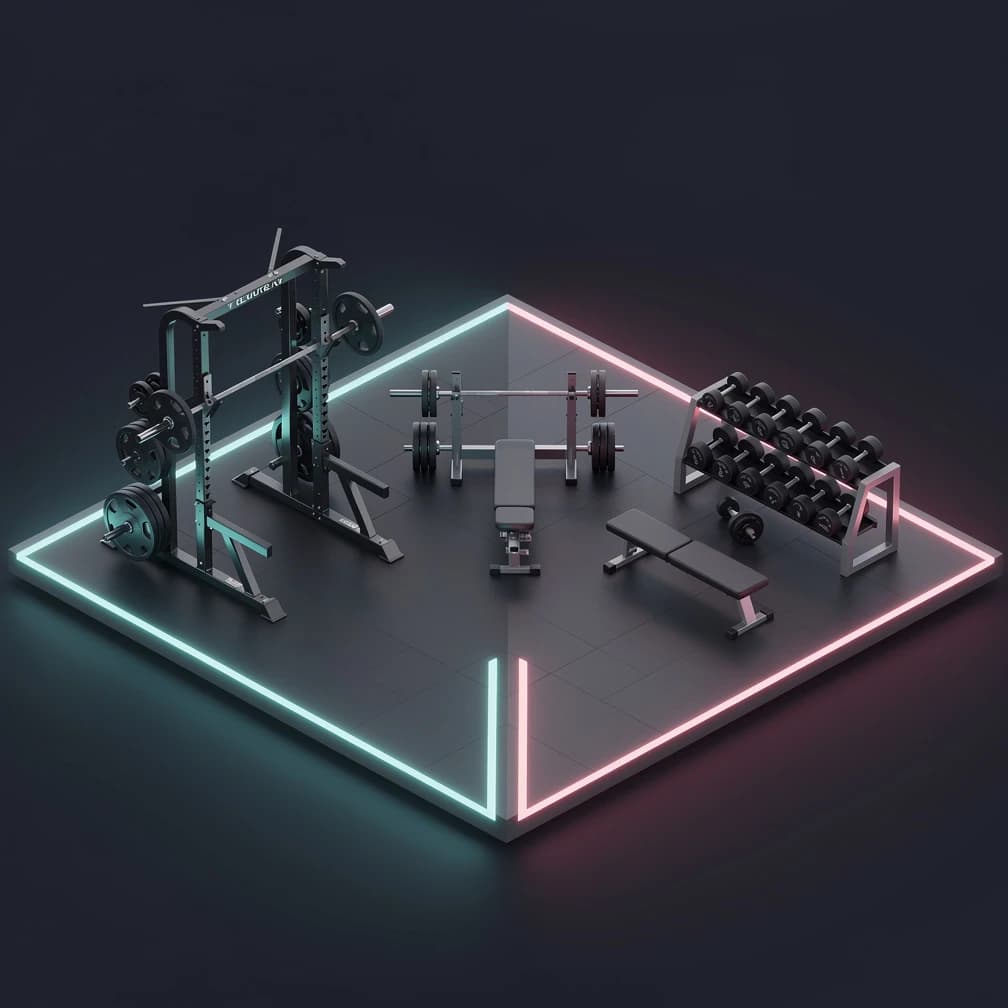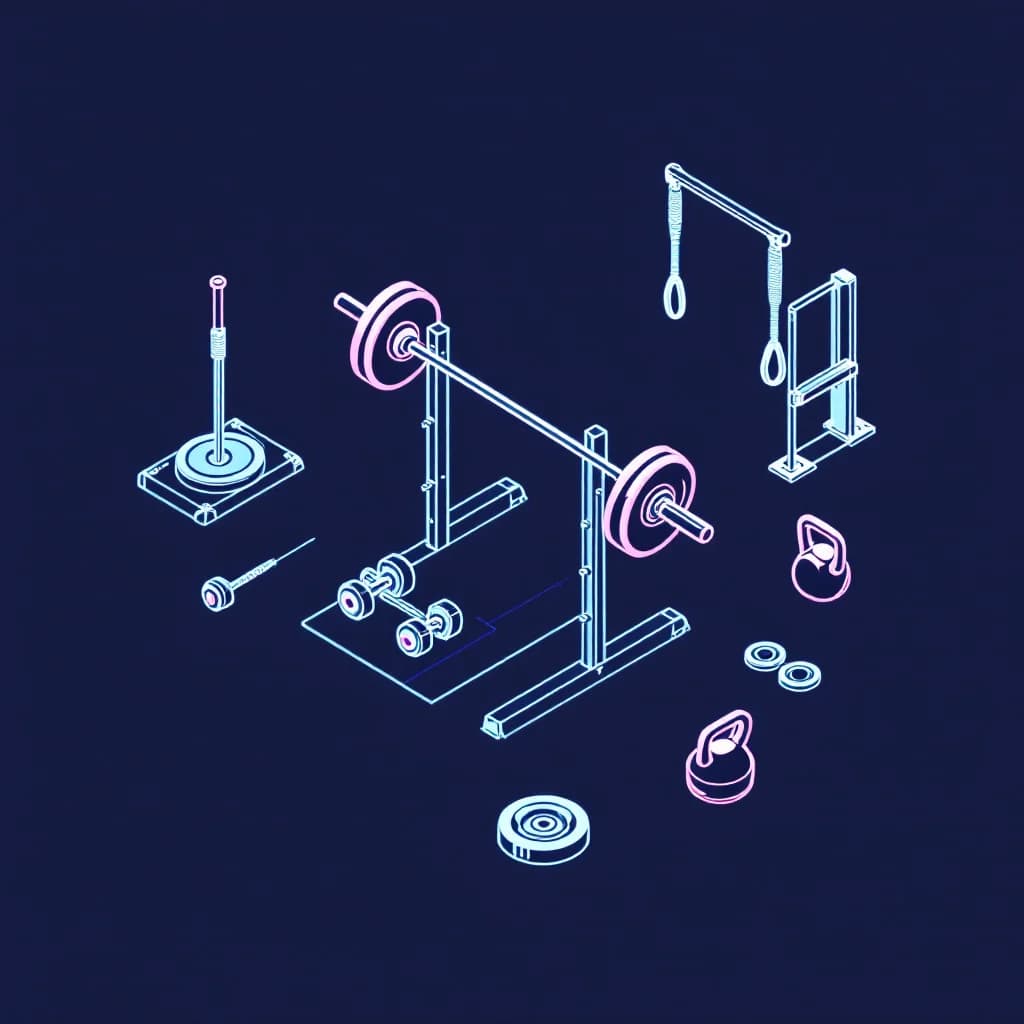
The five pieces of strength training equipment every coach should prescribe first are: a barbell, a squat rack with safeties, a weight plate set (minimum 300 lb), a flat bench, and a set of dumbbells. Everything else is a supplement to that core stack — cable machines, kettlebells, resistance bands, and specialty bars are high-value additions, but none of them can replace the compound loading stimulus that a barbell and rack provide. Equipment selection is not a preference question; it is a programming question. The wrong equipment limits the force-production demands on the musculoskeletal system and constrains adaptation.
This guide covers the complete equipment hierarchy for strength training: what each tool does, why the order of acquisition matters, how to match equipment to training goals, and the home gym build-out sequence coaches most commonly get wrong when advising clients.
Key Takeaways
- The non-negotiable foundation is barbell + squat rack + plate set (300 lb minimum): these three items unlock all primary compound movements and enable progressive overload from beginner to elite
- The barbell enables loading from 45 lb to 1,000+ lb across squat, hinge, press, and row patterns — no machine, dumbbell, or cable setup can replicate its loading range
- The trap/hex bar is the single highest-value secondary purchase for coaches with beginner or older clients: the neutral grip and centre-of-mass shift makes the hip hinge pattern more accessible and reduces spinal shear forces
- Cable machines provide continuous tension through the full range of motion — something gravity-dependent tools cannot match — making them the highest-value machine for hypertrophy and accessory work
- The most common equipment mistake coaches see from new clients is buying cardio equipment, isolation machines, or adjustable dumbbells before purchasing a rack and barbell — the compound loading stimulus is irreplaceable
- IronCoaching's program builder lets coaches tag exercises by required equipment so athletes know exactly what they need before their first training session
What Is Strength Training Equipment?
Strength training equipment refers to any tool or apparatus designed to provide progressive resistance against muscular contraction, facilitating improvements in strength, hypertrophy, power, and structural adaptation. The five essential items are the barbell, squat rack, dumbbells, cable machine, and weight plates — in that priority order. Equipment selection matters because it directly determines the force-production demands placed on the musculoskeletal system, which governs the quality and specificity of the physiological adaptation a client experiences.
A coach's first assessment of a new client's home gym setup should be whether the equipment allows for progressive overload across foundational movement patterns. Without the right gear, even the most precisely designed strength training program becomes limited in efficacy. The equipment is the physical infrastructure for the stimulus.
The American College of Sports Medicine's 2009 Position Stand on Resistance Training Progression establishes that free weights and multi-joint exercises produce superior neural and structural adaptations compared to machine-only training, particularly at beginner and intermediate levels. This evidence base is what drives the equipment hierarchy below.
The Foundation: Barbell and Squat Rack
The barbell and squat rack combination is the single most important piece of strength training equipment for any serious strength programme. It enables loading from 45 lb to elite levels exceeding 1,000 lb across the fundamental human movement patterns: squat, hinge, press, and row. No other piece of equipment replicates this loading range.
Rack types differ in safety and versatility. A power rack (four-post steel frame with adjustable safety pins) is the most versatile and safest option for solo training — it permits squats, bench presses, overhead presses, and rack pulls with built-in protection if a lift fails. Squat stands are two independent uprights: cheaper and lighter but less safe under maximal loads, particularly for solo bench pressing. Rack-and-attachment systems are modular designs expandable with pull-up bars, lat pulldown attachments, and cable units — the best choice when the budget grows incrementally.
Budget recommendations:
- Entry level ($300–500): Rep Fitness PR-1100 tier — adequate for beginners and intermediate lifters under 350 lb squat
- Mid-range ($500–900): Rep Fitness PR-4000 / Rogue Monster Lite tier — greater stability, 1,000 lb rated capacity, more attachment options
- Commercial ($900+): Built for daily heavy use, 1,500–2,000 lb rated capacity, essential for any facility seeing multiple clients daily
Barbell selection should match the training population. Standard Olympic bars are 20 kg (44 lb) for men and 15 kg (33 lb) for women with a 50 mm (2-inch) sleeve diameter. Stiff bars with minimal flex are the powerlifting standard; bars with controlled whip suit Olympic-style movements. Knurling aggressiveness ranges from passive (high-rep training, minimises hand tearing) to sharp (maximal lifts demanding maximal grip feedback).
Specialty bars worth knowing for a coaching practice:
- Safety Squat Bar (SSB): Padded yokes and forward-extending handles shift the load anteriorly, reducing shoulder and wrist strain. Ideal for clients with shoulder mobility limitations or those needing to reinforce an upright squat torso.
- Hex/Trap Bar: The lifter stands inside the hexagonal frame with a neutral grip, positioning the load at the body's centre of mass. This is one of the highest-value secondary purchases for coaches working with beginners or older adults — it makes the hip hinge pattern significantly more accessible and measurably reduces lumbar shear forces versus a straight-bar deadlift.
- Cambered Bar: A downward curve increases range of motion for squats and bench presses, useful for mobility-development blocks.
IronCoaching's program builder allows coaches to tag each exercise with its required equipment, so clients know exactly what rack configuration, bar type, and plate total they need before their first session.
Free Weights: Dumbbells and Kettlebells
Dumbbells are the most versatile unilateral training tool. They expose and correct bilateral strength asymmetries that barbells mask, allow independent limb loading when one limb is injured or restricted, and provide a broader exercise variety at any given load range — from bicep curls and lateral raises to single-arm rows and split squats.
Fixed dumbbells (individual cast-iron or rubber-coated pairs) are the commercial gym standard: fast to change, highly durable, and requiring no setup. For home gyms where floor space is limited, adjustable dumbbells (Bowflex 552, PowerBlock Sport series) replace an entire rack of fixed pairs with a single adjustable unit. The trade-off is slower weight changes and lower maximum loads, but the space savings are meaningful — a full fixed dumbbell rack (5–100 lb) requires 15–20 square feet; an adjustable pair requires less than 2.
Kettlebells are underrepresented in strength training programming relative to their value. Three movements alone justify their place: the kettlebell swing (explosive hip extension, posterior chain loading), the Turkish get-up (full-body stability, thoracic extension, anterior core strength), and the goblet squat (reinforces squat mechanics, anterior core bracing). For a coaching practice starting a kettlebell inventory, a three-bell set covers the majority of client capabilities: 16 kg, 24 kg, and 32 kg for male clients; 12 kg, 16 kg, and 24 kg for female clients.
Resistance bands serve as a zero-footprint complement to free weights. Their primary strength training applications are accommodating resistance (bands looped around the barbell increase load at the top of a lift where the movement is mechanically strongest, producing a more even strength curve across the rep), injury rehabilitation progressions, and dynamic warm-up routines. They are not a substitute for progressive free weight loading — the force they generate is non-linear, non-measurable, and non-comparable across sessions — but they add genuine value at negligible cost and zero floor space.
Cable Machines and Resistance Machines
The cable machine is the most versatile piece of gym machinery and, for coaches prioritising hypertrophy alongside strength, arguably the second-highest-priority purchase after the barbell-and-rack setup. Its defining advantage is continuous tension through the full range of motion — a characteristic gravity-dependent tools cannot replicate. Barbells and dumbbells only resist vertical pull; a cable machine resists in any direction the cable is set. This matters for exercises where the strength curve favours mid-range contraction (rows, pulldowns, cable flyes, face pulls) rather than the end-range peak typical of barbell movements.
Functional trainers (dual cable, two independent weight stacks) offer maximum versatility for a training facility. They can be configured for bilateral movements, two simultaneous users, rotational patterns, and sport-specific force angles. For home gyms, a single-cable pulley system mounted directly to a power rack provides cable-based exercise at modest cost — typically $150–350 for the attachment plus the rack already purchased.
Plate-loaded machines (leg press, hack squat, chest-supported row) earn their position in commercial settings because they allow very high loads on a fixed movement path, reducing injury risk when the primary goal is maximal loading and reduced stabilisation demand is acceptable. They are excellent for strength development when barbells are unavailable or when a client has a specific limitation requiring a guided movement arc.
Selectorized machines (pin-loaded, fixed-motion) are the lowest priority in a strength-focused environment. They are most appropriately used for: beginner clients building motor patterns before progressing to free weights, post-injury clients needing controlled loading, and isolated accessory work at the end of a session when the goal is targeted muscle fatigue without stabiliser loading.
The Schoenfeld 2017 meta-analysis on resistance training volume and muscle growth found no significant difference in hypertrophy outcomes between free weights and machines when volume is matched — but the practical programming advantage of free weights is the carry-over to functional strength that machines do not provide.
Home Gym vs. Commercial Gym Equipment
Coaches frequently advise clients on equipment acquisition — for a home training space, a private facility, or navigating the limitations of a commercial gym.
Minimum viable home gym ($1,200–2,000):
- Power rack or squat stands — $300–600
- Olympic barbell — $150–250
- Bumper or iron plate set (300 lb minimum) — $300–500
- Adjustable dumbbells or starter dumbbell set — $200–400
This setup enables every major compound movement: squat, deadlift, bench press, overhead press, barbell row, and dumbbell accessory work.
Expanded home gym ($3,000–6,000 adds):
- Pull-up bar or lat pulldown attachment (rack-mounted) — $100–200
- Functional trainer cable machine — $500–1,500
- Flat or adjustable bench — $150–400
- Resistance band set — $30–80
- Kettlebell set (16/24/32 kg) — $150–300
- Rubber flooring (¾-inch horse stall mats, 100 sq ft) — $150–250
Flooring is the single most overlooked item in home gym builds. Three-quarter-inch rubber mats protect the subfloor from dropped plates, reduce noise on dropped weights, and provide stable footing for heavy lifts. They are not optional — a standard basement concrete or wood floor will crack or warp under repeated deadlift drops and shifting equipment loads.
Commercial gym coaching: When coaching at a commercial facility, the question shifts from equipment selection to equipment utilisation strategy. The free-weight area, power racks, and cable stations are always the primary training zones. The principle to communicate to every client at a commercial gym is: free weights for the primary stimulus, machines for the supplement. Clients who build their training programme around the chest fly machine and leg extension, then occasionally pick up dumbbells, will plateau within months. Clients who build around squat racks and barbell rows, then use machines for isolation and accessory work, progress for years. The best workout split guide covers how to structure this across the training week.
Equipment by Training Goal
The right equipment priority changes significantly based on the client's primary training objective.
| Goal | Primary equipment | Secondary | Deprioritize |
|---|---|---|---|
| Powerlifting | Power rack, barbell, calibrated plates | Safety squat bar, lifting box, belt | Cable machines |
| Hypertrophy | Barbell, dumbbells, cable machine | Plate-loaded machines | Cardio equipment |
| General strength/health | Power rack, barbell, adjustable dumbbells | Kettlebells, resistance bands | Specialty bars |
| Athletic performance | Barbell, hex trap bar, resistance bands | Medicine ball, sled | Selectorized machines |
| Post-rehabilitation | Resistance bands, cable machine, light dumbbells | Seated machines | Heavy barbell loading initially |
For powerlifting clients, calibrated competition plates (steel, accurate to within 0.25%) matter more than the type of machine available — their programming is barbell-and-rack-centric, and the specific bar they train on should match the federation's equipment as closely as possible. For hypertrophy clients, the cable machine becomes more significant because the continuous-tension advantage produces measurably more mechanical work at mid-range where many muscles are longest and most under tension. The types of workouts guide covers how these goals translate to programming structures.
What to Buy First: The Equipment Priority Stack
For coaches advising clients on home gym purchases, a clear acquisition sequence prevents wasteful spending and ensures the foundational stimulus is in place before supplementary tools arrive.
Priority 1 — Power rack + Olympic barbell + plate set: Non-negotiable. This combination enables every primary compound movement with the capacity for progressive overload from the first training session to an advanced level. Without it, genuine strength training is not possible. This is what the progressive overload training framework is built around — adding weight to the bar, week over week.
Priority 2 — Flat or adjustable bench: Unlocks horizontal push (bench press) and incline pressing patterns, plus dumbbell rows. An adjustable bench (0° to 85°) is worth the additional $80–150 over a fixed flat bench.
Priority 3 — Dumbbells ($5–50 lb range minimum): Essential for unilateral work, injury workarounds, and accessory movements the barbell cannot efficiently address — lateral raises, bicep curls, single-arm presses, Bulgarian split squats.
Priority 4 — Pull-up bar (rack-mounted or doorframe): Vertical pulling without a cable machine. The rack-mounted version is preferable because it doubles as a dip station with the right attachment.
Priority 5 — Resistance bands: Low-cost, zero-footprint utility for warm-ups, accommodating resistance added to the bar (a common technique in the 5/3/1 programme and Westside-influenced training), and rehabilitation progressions.
The most common error coaches see when clients describe their home gym: a rowing machine, a Peloton, and a set of light dumbbells — and no rack, no barbell, and no plates. Those items cannot substitute for a compound loading stimulus. The barbell is irreplaceable; everything else supplements it.
Equipment Safety and Maintenance
Coaches who advise home gym clients have a responsibility to ensure the equipment is used and maintained safely.
Spotter arms and safety catches are the most critical safety feature in a power rack. The safety pins catch the bar if a squat or bench press fails. Clients must set safeties at the correct height — typically 1–2 inches below the bottom position of the lift — before every session. Incorrectly set safeties that are too high prevent a full range of motion; safeties set too low fail to catch the bar on a failed rep. Demonstrate the correct height calibration during the first session with every new client.
Load capacity ratings must be respected. Residential-grade racks are typically rated to 500–1,000 lb; commercial-grade racks to 1,000–2,000 lb. Coaches should know their client's projected training maxima and confirm the rack's rated capacity exceeds them with a safety margin. Overloading a rack is a structural failure hazard.
Barbell maintenance is simple and often skipped. Wiping chalk and sweat off the bar after sessions prevents corrosion and preserves knurling. Oiling the sleeves every three to four months ensures the collars rotate freely during Olympic lifts and keeps the bar mechanism smooth.
Plate and equipment storage: J-hooks on the rack, weight horns, and dumbbell trays keep the floor clear. Tripping on a loose plate or rolling dumbbell is among the most common causes of gym injury in home training environments. An uncluttered floor is a safety standard, not a preference.
Flooring: Three-quarter-inch rubber mats (horse stall mat density) are the minimum for any space with barbell work. They protect the subfloor from impact loading, reduce noise transmission, and provide stable footing under a heavy squat or deadlift. This is the one safety investment that protects both the building and the athlete.
For coaches managing multiple clients across different training environments, IronCoaching's online strength coaching tools allow coaches to build programmes specific to each client's available equipment — the platform supports equipment-tagged exercise libraries so the program builder surfaces only movements the client can actually execute.
Pro tip
When advising a client on their first home gym purchase, start with one question: "Can you do a barbell squat, deadlift, bench press, and overhead press here?" If the answer is no, everything else is secondary until the rack and barbell are in place.
Frequently Asked Questions
The barbell and squat rack combination is the single most important piece of strength training equipment. It enables loading from 45 lb to 1,000+ lb across the fundamental movement patterns — squat, hinge, press, and row — making progressive overload possible from beginner through elite level. No machine, dumbbell, or cable setup can replicate this loading range or the neural demand of coordinating a barbell under submaximal to maximal load.
Buy the rack, barbell, and plates first. A power rack or squat stands ($300–600) plus an Olympic barbell ($150–250) plus a 300 lb plate set ($300–500) gives you a minimum viable strength training setup for approximately $1,200. Add a flat bench second, then adjustable dumbbells third. Do not buy cardio equipment, selectorized machines, or isolation tools until the compound loading foundation is in place.
Yes — a cable machine is the highest-value machine for coaches prioritising hypertrophy alongside strength. Cable machines provide continuous tension through the full range of motion, which gravity-dependent tools cannot replicate. This makes them especially effective for rows, pulldowns, cable flyes, and rotational movements where the strength curve favours mid-range loading. For home gyms, a single-cable pulley system attached to a power rack is a cost-effective starting point ($150–350).
Beginners benefit most from a barbell and rack setup — not machines. The ACSM's 2009 Position Stand on Resistance Training Progression confirms that free weight, multi-joint exercises produce superior neural and structural adaptations at beginner levels compared to machine-only training. For beginners concerned about safety or movement quality, the hex/trap bar is an excellent alternative to the straight-bar deadlift as a starting point.
A minimum viable home gym for strength training costs $1,200–2,000: power rack ($300–600), Olympic barbell ($150–250), plate set ($300–500), and adjustable dumbbells ($200–400). Expanding to include a cable machine, flat bench, kettlebell set, and rubber flooring brings the total to $3,000–6,000. A full commercial-grade setup starts at $10,000 for the equipment alone before flooring and space costs.
Powerlifters need a power rack with at minimum 1,000 lb rated capacity, a stiff competition-style barbell, calibrated steel plates, a flat bench with spotter arms, and a deadlift mat or platform. Secondary equipment includes a safety squat bar, a lifting box (for box squats and pin presses), a belt, and chalk. Cable machines and selectorized equipment are generally low-priority for powerlifting-specific programming.
Sources & References
- ACSM Position Stand: Progression Models in Resistance Training for Healthy Adults (2009) — Evidence base for free weight superiority in beginner and intermediate adaptation
- Schoenfeld et al. 2017 — Dose-response relationship between weekly resistance training volume and increases in muscle mass — Volume and adaptation evidence referenced in cable machine section
- ACE Fitness — Home Gym Equipment Essentials — Budget and setup reference for home gym recommendations
- NSCA Strength and Conditioning Journal — Equipment safety and selectorized machine guidelines for novice trainees